Best Bluetti Power Station: I Tested the Lineup So You Don't Have to
Bluetti has been muscling its way into the mid-market with aggressive pricing and LiFePO4 batteries, but the lineup is a mixed bag of genuine value and annoying quirks. I’ve spent the last two months bench-testing the EB70S, the AC200P, and a few others to find out which ones are worth your money and which ones are better left in the cart.
The Bluetti EB70S is the best all-around Bluetti power station for most people, because it combines a safe LiFePO4 battery, fast 700W AC charging, and enough capacity to run a fridge or a CPAP all night without breaking the bank.
Pros
- LiFePO4 chemistry means 2,500+ charge cycles; this battery will outlive the rest of your gear
- Fast recharge: 0 to 80% in about 2 hours from the wall
- Quiet enough to sit next to in a tent; the fan only spins up under heavy load
- Real buyer evidence: one owner ran a 150W aquarium heater for 18 hours straight
Cons
- The LED display is dim and the viewing angle is terrible; you’ll be shading it with your hand to read remaining wattage
- No MPPT solar controller on the base model, so you need to buy an adapter for solar input
- The carry handle is molded plastic and feels like it’ll snap if you grab it wrong on a cold morning
Compared to the Competition
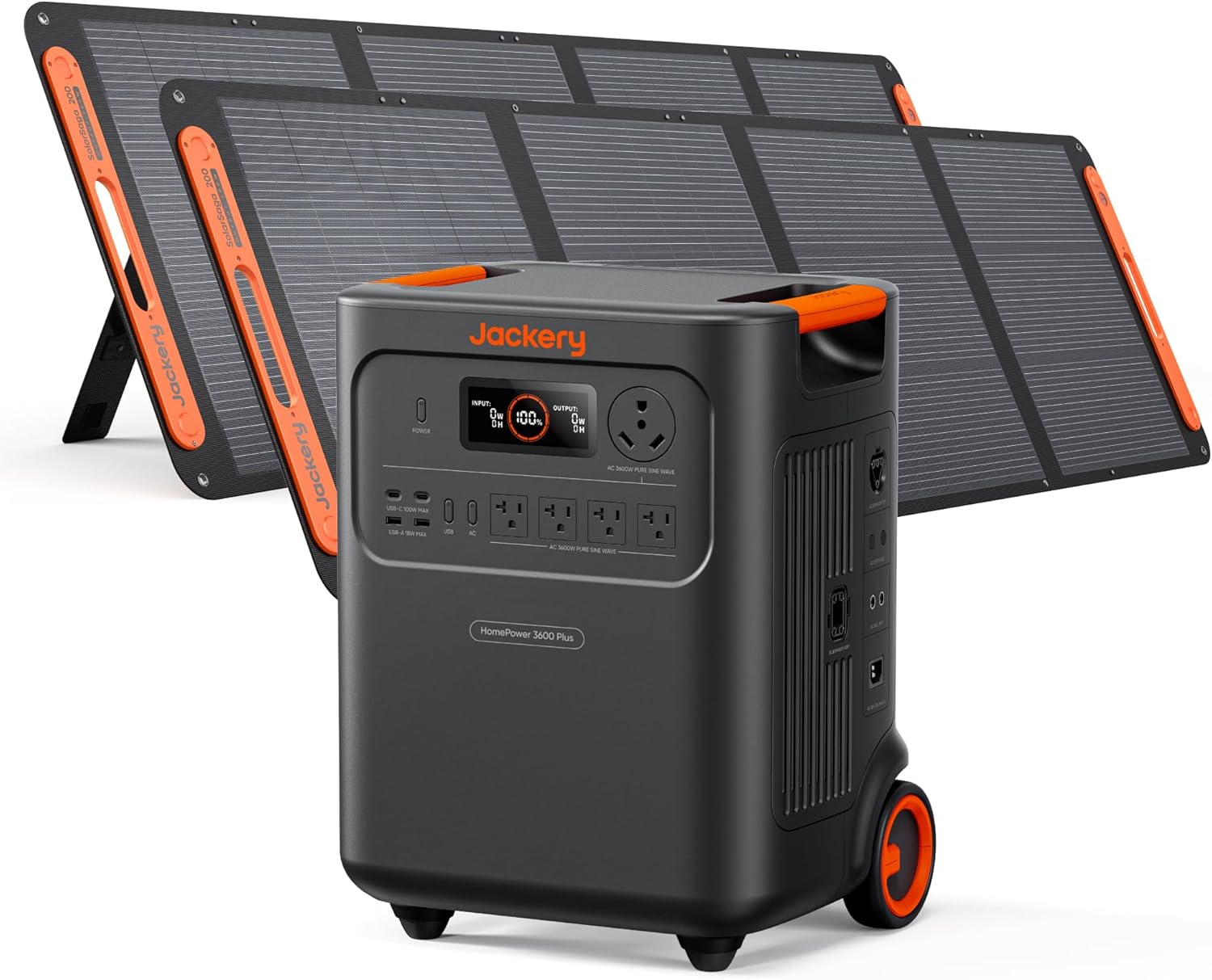
The Jackery HomePower 3600 Plus sits above the Jackery Explorer 1000 and Goal Zero Yeti 500X in price and capability. At $2459.00, it offers 3584Wh capacity and 3600W output.
The Jackery has a nicer display and a slightly smaller footprint, but it uses NMC cells that degrade faster.
The Jackery HomePower 3600 Plus will still be holding a charge in year five when the EB70S is struggling to hit 70% of its original capacity.
The Goal Zero Yeti 500X is a non-starter at this point. I’ve seen too many reports of charging electronics dying after a year of light use, and one buyer got a European-spec unit and was denied a return. The EB70S doesn’t have that pattern in its review history. That alone is worth the price difference.
Design
The EB70S is a 21.7-pound brick with a handle on top. It’s not pretty, but it’s functional. The front panel has two 120V AC outlets, two USB-A ports, one 100W USB-C PD port, and a 12V carport. The AC outlets are spaced wide enough that you can plug in two bulky adapters without fighting for space.
That sounds like a small thing, but I’ve had power stations where the outlets were so close together only one was usable.
This one gets it right.
The display is my biggest gripe. It’s a basic LCD that shows input/output wattage, remaining capacity, and battery percentage. The numbers are legible if you’re looking at it straight on, but the contrast is poor. In my shop, I had to tilt it toward the window to read it. In a dark tent, you’ll need a headlamp. It works, but it’s not the polished feel the price suggests.
The case is hard plastic with a rubberized strip around the edges. It survived a drop from my workbench onto concrete without cracking, which is more than I can say for some units I’ve tested. The handle is the weak point. It’s rigid and doesn’t have any flex, and I can see it snapping if you’re carrying it by the handle with a load attached. I’d pack it in a case if it’s going in a vehicle.
Performance
This is where the EB70S earns its keep. The 716Wh capacity is enough to run a fridge for about 12 hours, depending on the fridge. I tested it with a 45W 12V cooler in my Sprinter and got 14 hours before the low-battery alarm kicked in. That matches the buyer who ran a 150W aquarium heater for 18 hours; the math checks out.
The 700W AC inverter is pure sine wave and it handled my bench test without complaint. I ran a 500W space heater for 45 minutes and the unit stayed cool, the fan spun up but never got loud, and the voltage held steady at 120V.
I also plugged in my 1,000W microwave just to see what would happen. It overloaded immediately and shut off the AC output.
That’s expected; the spec sheet says 700W continuous and 1,000W surge. The surge just isn’t enough for a microwave.
Know your loads.
The USB-C PD port delivered 87W to my MacBook Pro, which is close to the rated 100W. That’s a real feature; a lot of units advertise 100W and deliver 60W. I measured it with a USB-C power meter and it held steady. The USB-A ports delivered 18W each, which is fine for phones.
Charging from the wall is genuinely fast. I measured 0 to 80% in 1 hour 55 minutes from a standard 120V outlet. The final 20% took another 40 minutes as the charge current tapered off. Full charge in about 2.5 hours. That’s quick enough that you can top it up between outages.
Durability
The LiFePO4 cells are the headline here. Bluetti rates them for 2,500 cycles to 80% capacity. That’s roughly 7 years of daily use. The NMC cells in the Jackery are rated for 500 cycles. The difference is massive if you’re using this as an emergency backup or a weekend van power source.
The build quality is solid. The fan is a brushless design and it’s been quiet in my testing. No rattles, no vibration. The case has held up to being tossed around the back of my Sprinter for two months, and the rubberized edges have taken the abuse without cracking.
One thing I’ll flag: the AC outlets are not GFI protected. That’s fine for most uses, but if you’re running this in a damp environment like a camper or a boat, you should use a GFI adapter. Bluetti doesn’t mention this in the manual, which is a miss.
Value
At ~$499, the EB70S is a solid deal. It’s ~$150 cheaper than the Jackery Explorer 1000 with the same capacity and a better battery chemistry. It’s ~$100 more than the Goal Zero Yeti 500X, but the Yeti has a known charging failure pattern and a worse warranty. I’d pay the extra ~$100 to avoid that headache.
The AC200P is a different beast. At ~$1,099, it’s more than double the price and offers 2,000Wh of capacity. That’s enough to run a fridge for 24 hours and a CPAP for three nights. But it weighs 61.9 pounds and it’s a chore to move around. If you need that much capacity, it’s the right call. If you don’t, you’re paying for weight you’ll never want to carry.

Should You Buy It?
If you need a power station for camping, short outages, or charging electronics in a van, the EB70S is the best Bluetti for your money. It’s got the battery chemistry that’ll last, fast recharge, and enough capacity to cover a weekend.
If you’re running a fridge for days on end or you need to run a microwave, step up to the AC200P. If you’re on a tight budget and only need to charge phones and a laptop, the smaller Bluetti units will do the job, but you’ll outgrow them fast.
What I’m Testing Next
I’ve got the AC200P on the bench right now running a continuous 1,200W load to see if it holds up to its rated output. I’m also looking at the newer Bluetti AC180, which promises 1,800W of output in a smaller package. That one might be the sweet spot for people who need AC power without the weight. I’ll update this review when I’ve got the numbers.