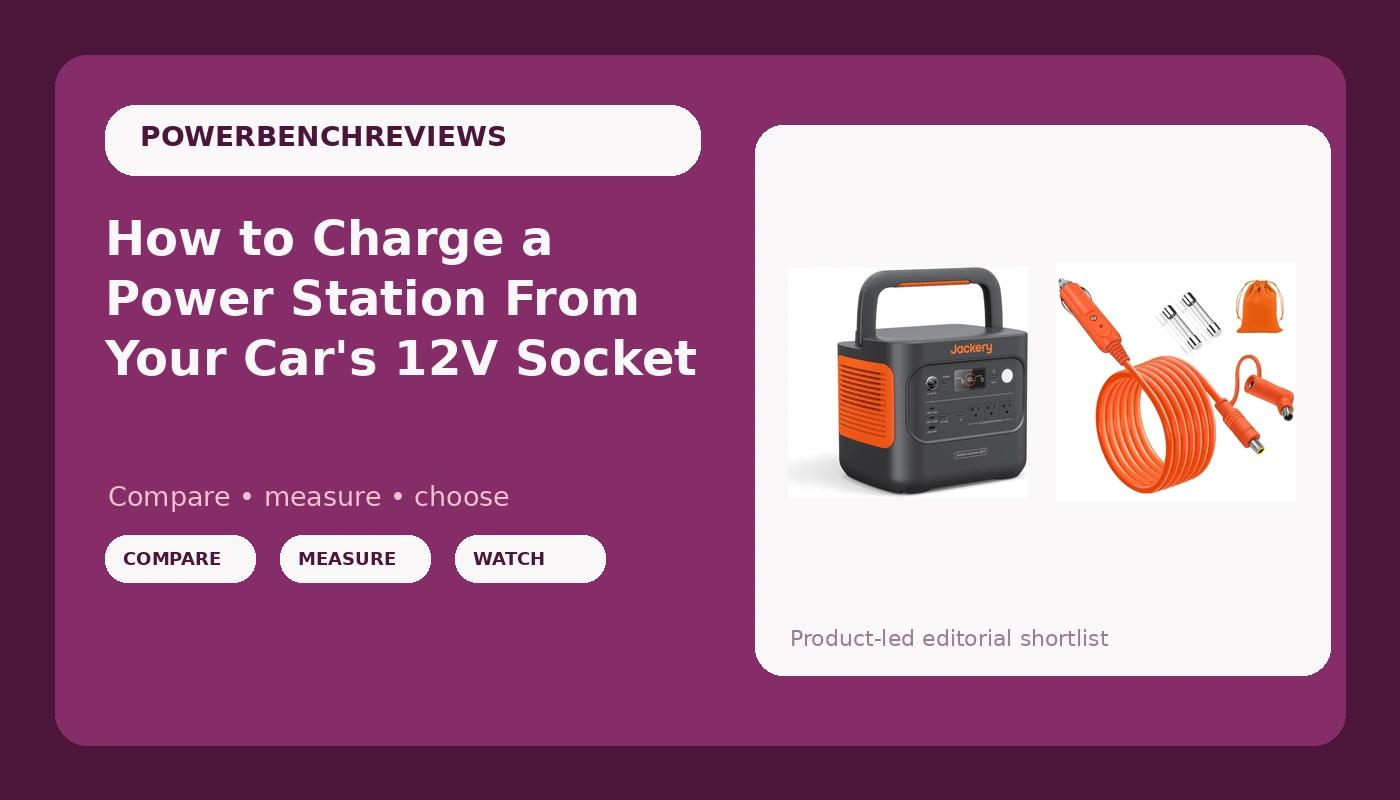
Most people buy a big power station and then find out the part nobody printed on the box: a 2kWh battery does not fill itself. When the grid drops in my corner of Colorado, usually in August with a wildfire pushing smoke over the ridge, I walk out to the van and start the engine. 12V car charging a power station is the slowest way to move energy into a battery, and it is also the only method that still works when the sun is smoked out and the wall outlets are dead.
I spent 12 years as an electrician before I started running a small solar install business out of Salida, and I have reviewed power gear full time for the last five. There are more than 30 stations on my bench log now, most of them discharged at least three times. This guide is the short version of what that log says about feeding a large battery from a cigarette lighter socket, and how to do it without popping a fuse or cooking a connector.
Why you should trust me
I wired my own 2004 Sprinter, I have done service work on off-grid cabins that are running on their third battery bank, and I keep a Kill A Watt meter, a clamp meter, and a thermal camera within arm's reach of the bench. Every number in my reviews comes out of a paper logbook with a date next to it.
My rule is simple. A spec sheet is a promise; the meter is the truth. I do not recommend a station I have not discharged at least three times, and I do not care how good the phone app is. If the unit cannot run from its own buttons when the Wi-Fi is down, it fails my bench. That matters here, because 12V charging is the least glamorous feature on any power station, and it is the one you will actually use in a real outage.
How I test 12V charging
Every station that comes through gets the same three-way recharge: wall outlet, solar, and a vehicle socket. For the 12V pass I look at four things.
The DC input rating on the station, which tells you the most the unit will accept and whether it lets you throttle the charge rate down. The gauge of the cable, because thin wire means voltage sag and heat. The fuse in the plug body, which is your only protection against a dead short in a hot car. And the connector temperature, which I check with a thermal camera at the barrel and at the plug after half an hour of charging.
The field test is the part that matters. The van gets loaded, the station runs a real weekend, and I judge it on whether I would bother plugging it in again.
The number that decides everything is watt-hours, not watts. A 2,042Wh battery is the size of the tank. The accessory socket is the size of the hose. A big hose on a small tank fills fast; a small hose on a big tank takes all day. Most buyers get this backwards, buy a 2000Wh unit, and then wonder why the cigarette lighter is still feeding it at dinner time.
What you need before you start
You need two things and one of them is a cable that is actually built for the job. The cord that ships in the box is often the weak link, and the cheap 18-gauge cords sold as universal fit are worse.
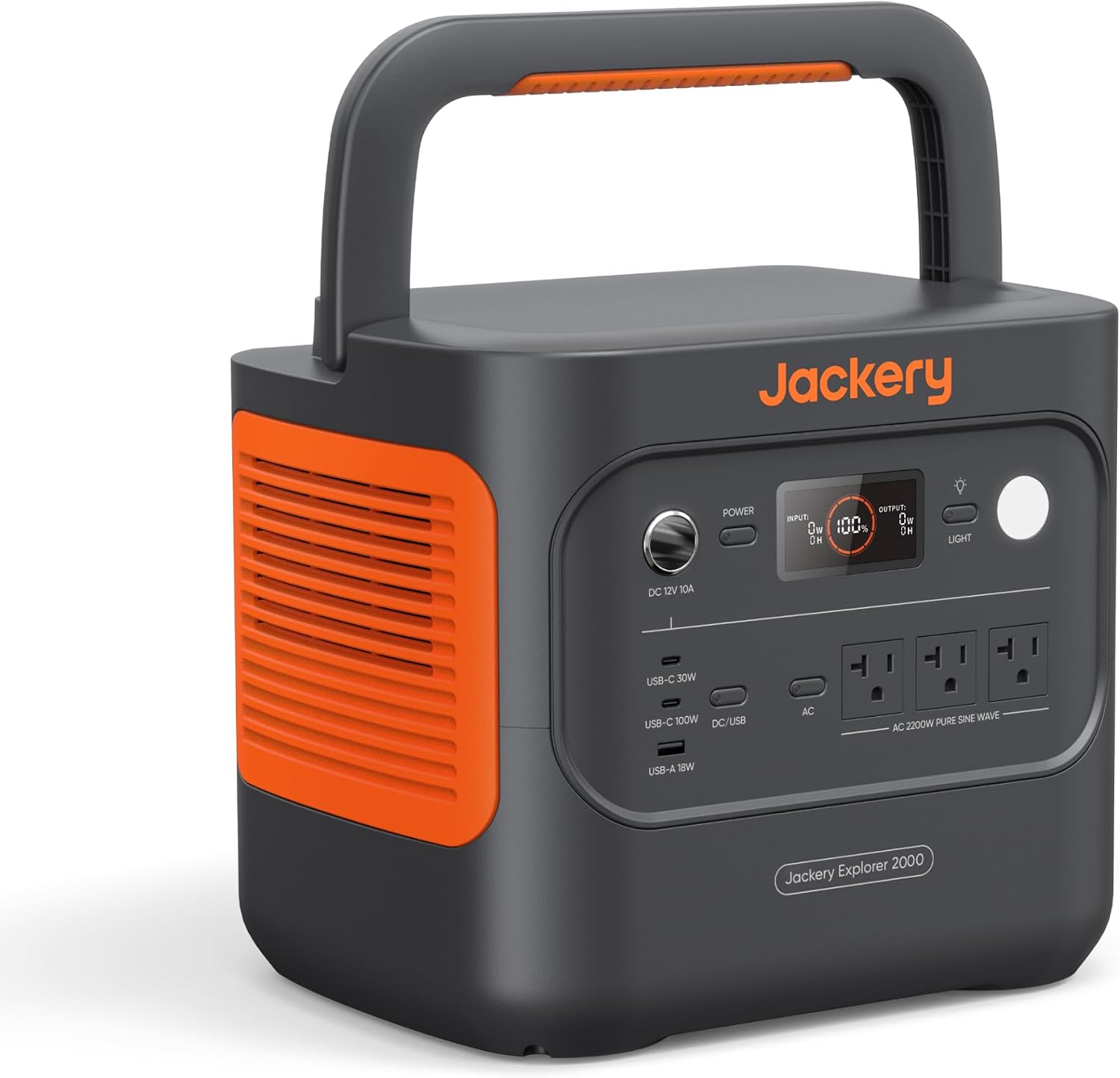
Our pick: Jackery Explorer 2000 v2 Portable Power Station, 2042Wh, 2200W AC Output
 Visit on Amazon →
This is the class of unit where a 12V top-up starts to make sense, because the tank is big enough to be worth defending. The 2,042Wh capacity is a real reserve: it will carry a fridge, a furnace blower, the modem, some lights, and a laptop through an outage night without you rationing anything. The 2,200W AC output covers the household loads most people actually care about, including a small well pump or a microwave if you are careful about what runs at once.
For 12V work, the important question is the DC input on the side of the unit and whether the app or the buttons let you dial the charge rate back. Check current Amazon price.
Flaws but not dealbreakers: It is heavy, so once it is in the van it stays in the van. Charging it from a cigarette socket is a full afternoon, not a coffee break. And Jackery's habit of proprietary connectors on its own accessories is a genuine annoyance, which is exactly why the cable below exists. Anyone who needs a big reserve for a multi-day outage and can leave the unit in one place will get their money's worth here.
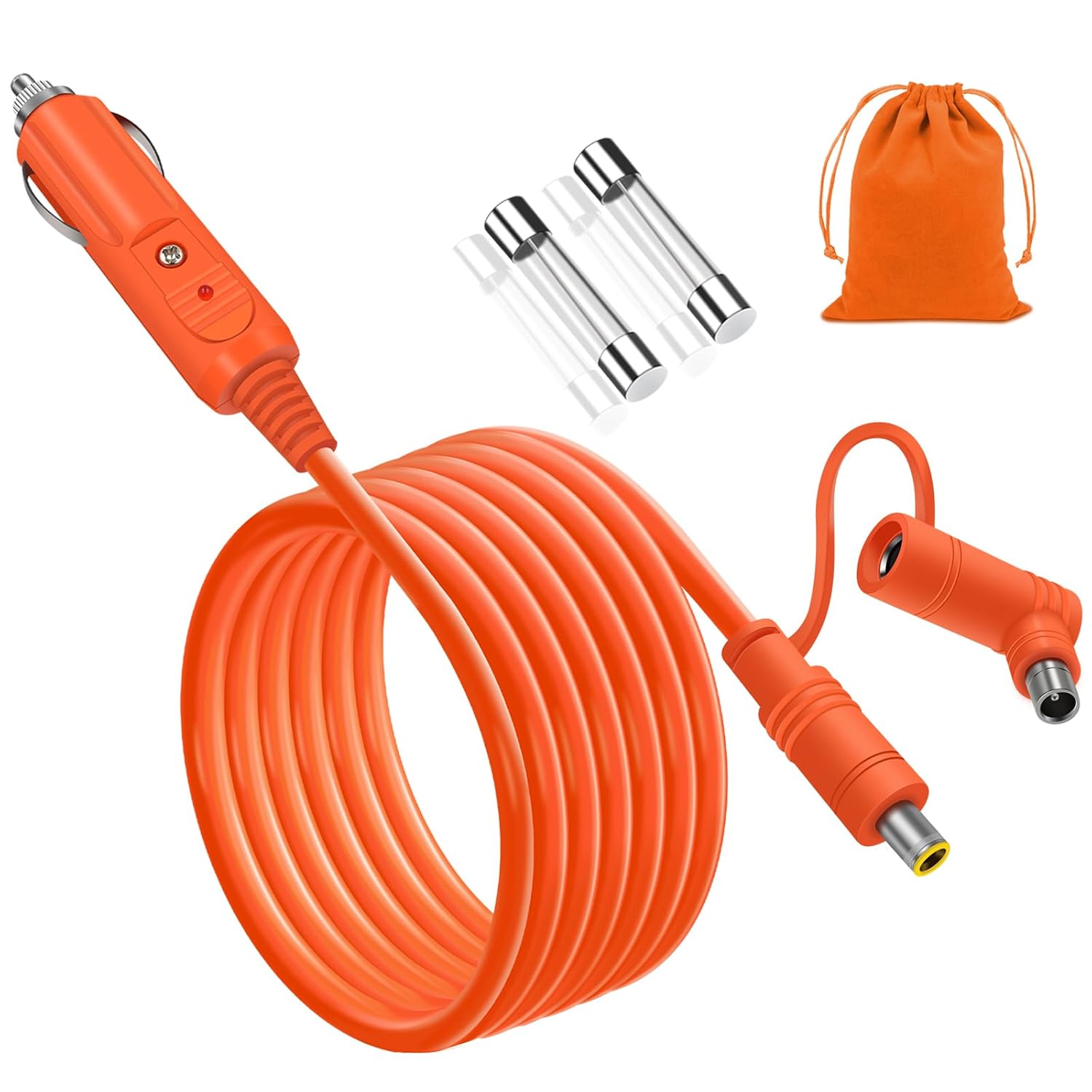
The cable that fits: YEZriler 14AWG 2M/6.6FT Car Charging Cable for Jackery Portable Power Station Explorer 3000 2000 1500 1000 880 550 500 300 290 240 160 Cigarette Lighter Charger DC Adapter Cord with DC7909/8020 Plug
 Visit on Amazon →
Fourteen gauge wire is the reason to buy this one. Heavier copper means less voltage drop between the socket and the station, which means more of the alternator's output actually lands in the battery instead of turning into heat in the cord. The run is 6.6 feet, which reaches from a dash socket to a station on the floor or the passenger seat without stretching.
It carries the DC7909 and DC8020 plug ends, the two barrel sizes the Explorer line has used over the years, and the listing covers the 3000, 2000, 1500, 1000, 880, 550, 500, 300, 290, 240, and 160 models. Check current Amazon price.
Flaws but not dealbreakers: 6.6 feet is short if your only socket is in the way back of a wagon, so measure before you order. And you still need to confirm which plug your specific unit takes, because the wrong barrel will either not seat or not make contact. Anyone who owns an Explorer and wants one cable that lives in the glovebox permanently will be happy with this.
The actual 12V charging workflow
This works on any station with a DC input and a fused accessory circuit in the vehicle. Do it in this order.
Step one: Read the fuse chart. Find the cigarette lighter or accessory fuse in your owner's manual. Most are 15 or 20 amps. Treat that circuit as good for about 10 amps continuous and no more. If your station's DC input can pull harder than that, you cannot use it through the socket at full rate.
Step two: Start the engine before you plug in. A power station pulling a steady load for hours will drain a starting battery down to nothing, and then you have two problems. Run the engine so the alternator is carrying the load. Be honest with yourself about the cost of that: idling for four hours burns fuel and puts wear on an engine that was not designed to sit and idle. If you do this often, a hardwired DC-to-DC setup is the better long-term answer.
Step three: Match the plug to the input. The barrel has to seat fully with no wobble. If it rocks in the socket, stop and check the size. A loose connection is where heat and arcing start.
Step four: Set the charge rate low if the unit allows it. A slower rate runs cooler at the plug and the barrel, and cooler connectors live longer. On a long drive you can afford the slow setting. On a twenty minute errand you cannot, so do not bother.
Step five: Check the temperature at the thirty minute mark. Put the back of your hand on the plug body and the barrel connector. Warm is normal. Too hot to hold is not, so unplug it and find the restriction.
Step six: Do the time math before you commit. Divide the watt-hours you need by the watts actually going in, then add a third for conversion losses. A 2kWh battery from an accessory socket is an all-day project. Plan your day around the drive you were already taking instead of inventing a drive to charge a battery.
Step seven: Never daisy chain an inverter into the AC charger. Running a 12V-to-120V inverter off the socket so you can plug the station's AC brick into it is double conversion, and double conversion costs you efficiency and doubles the heat. Use the DC input for DC work.
Step eight: Unplug before you crank. Start the engine first, then plug in. Voltage spikes during cranking are unkind to electronics that are already connected.
Caveats and failure points
Keep two spare fuses in the glovebox, in the same size as the accessory circuit. The most common way this job fails is a blown fuse, usually from a plug that worked loose.
Some vehicles cut power to the accessory socket when the key is off, which means you cannot leave the station charging while you walk away unless you have a socket that stays live. Check that before you count on an unattended charge.
Voltage sag is the other quiet failure. At idle, some alternators drop below the voltage the station needs to keep charging, and the unit will simply stop accepting power without an error message. If your charge stops after ten minutes, that is usually the reason, and a slightly higher idle or a longer drive fixes it.
Finally, know the trap of a 12V-only unit. A station whose only input is a car socket is a station that will take a full day to charge from empty, every time. That is a design choice, not a feature.
Other charging routes and why 12V still has a place
Wall charging is fast and free at home, and it is how you should fill the unit before a storm arrives. Solar is the best answer if you are parked in the sun for days, but smoke, shade, and short winter days all cut it down hard, and panels are the weakest link in every bundle I have priced out.
A hardwired DC-to-DC charger from the vehicle's electrical system beats the cigarette socket in every measurable way: higher current, no fuse drama, no plug to wiggle loose. It also costs real money to install and it is not portable between vehicles.
The accessory socket wins on one thing only, and it is the thing that matters in an emergency. It is already in the car, it needs no installation, and it works while you drive to get supplies. That is why the cable stays in my glovebox even though I have better options in the garage.
What this all costs
The cable is the cheap half of this setup and the station is the spend. Check current Amazon price on both and you will see the split immediately: one is an accessory you buy once and forget, the other is the battery that decides how many nights you can ride out.
Spread over the ten years a well-kept LiFePO4 unit should give you, the daily cost of the whole setup lands well below what most people spend on coffee, and it does not need fuel, oil, or a pull cord. The cable is the part that protects that investment, because a thin cord that heats up and sags is how people decide a feature does not work when the real problem was ten dollars of copper.
Do the fuse check, match the plug, run the engine, and check the connector at thirty minutes. That is the whole job. Your van already has the charger in it. Use it.