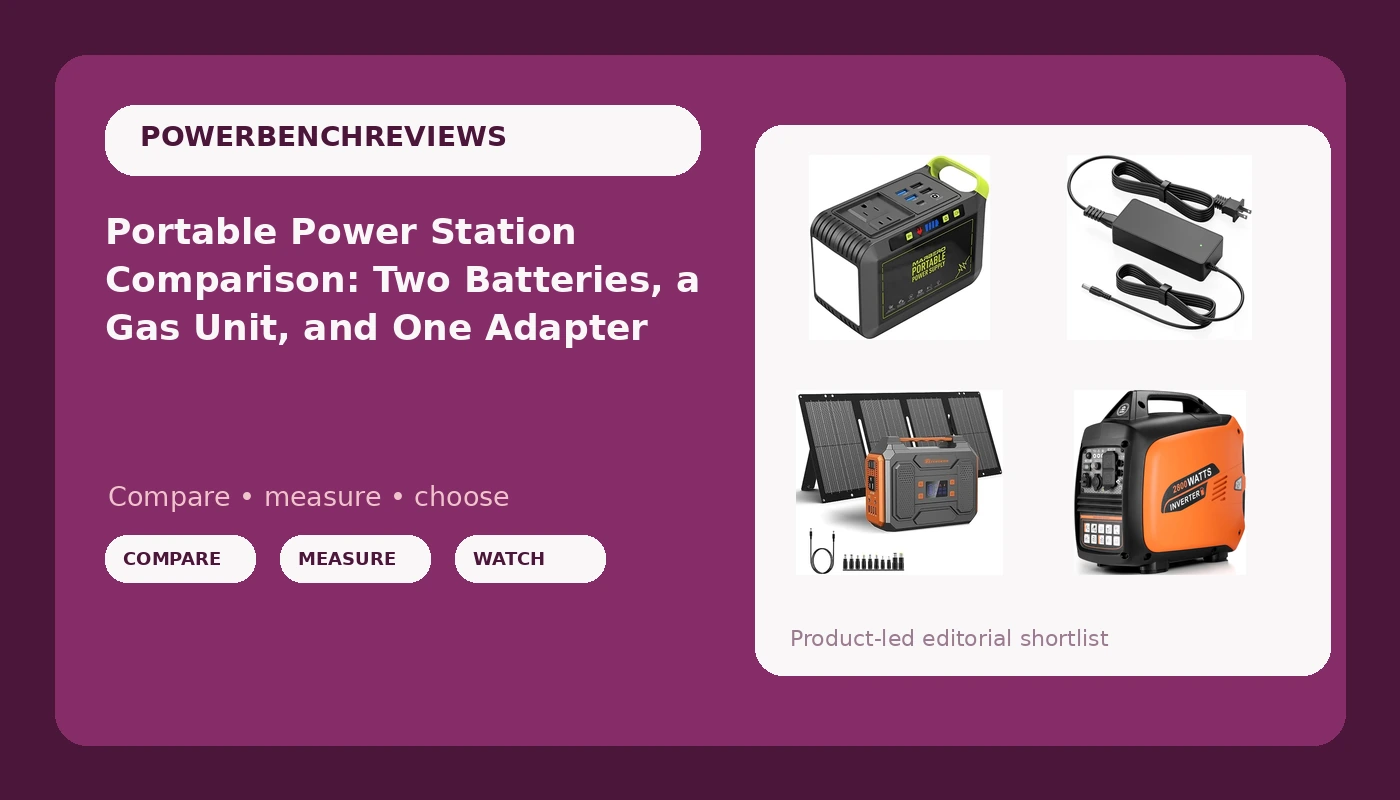
Every June, the grid in my corner of Colorado starts dropping for days at a time, and every June I get the same question from a neighbor: which box do I plug the fridge into? That question is the reason I keep writing a portable power station comparison instead of just reviewing whatever landed on the bench this month. Most people buy the wrong class of gear, spend three times what the job actually requires, and then blame the technology when a small inverter trips on a well pump.
I'm Dan. I spent 12 years as an electrician, I run a small solar install business out of Salida, and I live in a mountain town where wildfire season means the utility cuts power preemptively and leaves it off for days. My rule for gear like this is simple: watt-hours are the product, watts are the marketing. Everything below gets judged on that.
Related: How To Size A Power Station To Your Real Load
The short version: for phones, laptops, lights, and a router, the 88Wh MARBERO is the cheap answer and the 300W solar bundle is the more flexible one. The 2800W Oxseryn gas unit only makes sense if you genuinely need to run a fridge, a well pump, or a sump pump for days at a time. The Jackery 24V adapter is not a power station at all, it is the cheapest way to keep an Explorer you already own charging at full speed.
What is actually in this lineup
Four products, three different jobs, and one that is not a power station.
Two of them are battery units with an AC inverter built in. One is a gasoline inverter generator that makes its own power from fuel. One is an AC adapter, a charging brick, a replacement cord for a family of Jackery units that a lot of people already own and quietly stopped using because the original brick died or walked off.
Mixing those four in one table is deliberate. The single most common mistake I see is people comparing a 88Wh pocket unit against a 2800W fuel burner as if they were the same purchase. They are not competing. They solve different problems at different price points with different levels of noise, maintenance, and risk, and the table below is honest about that.
The comparison table
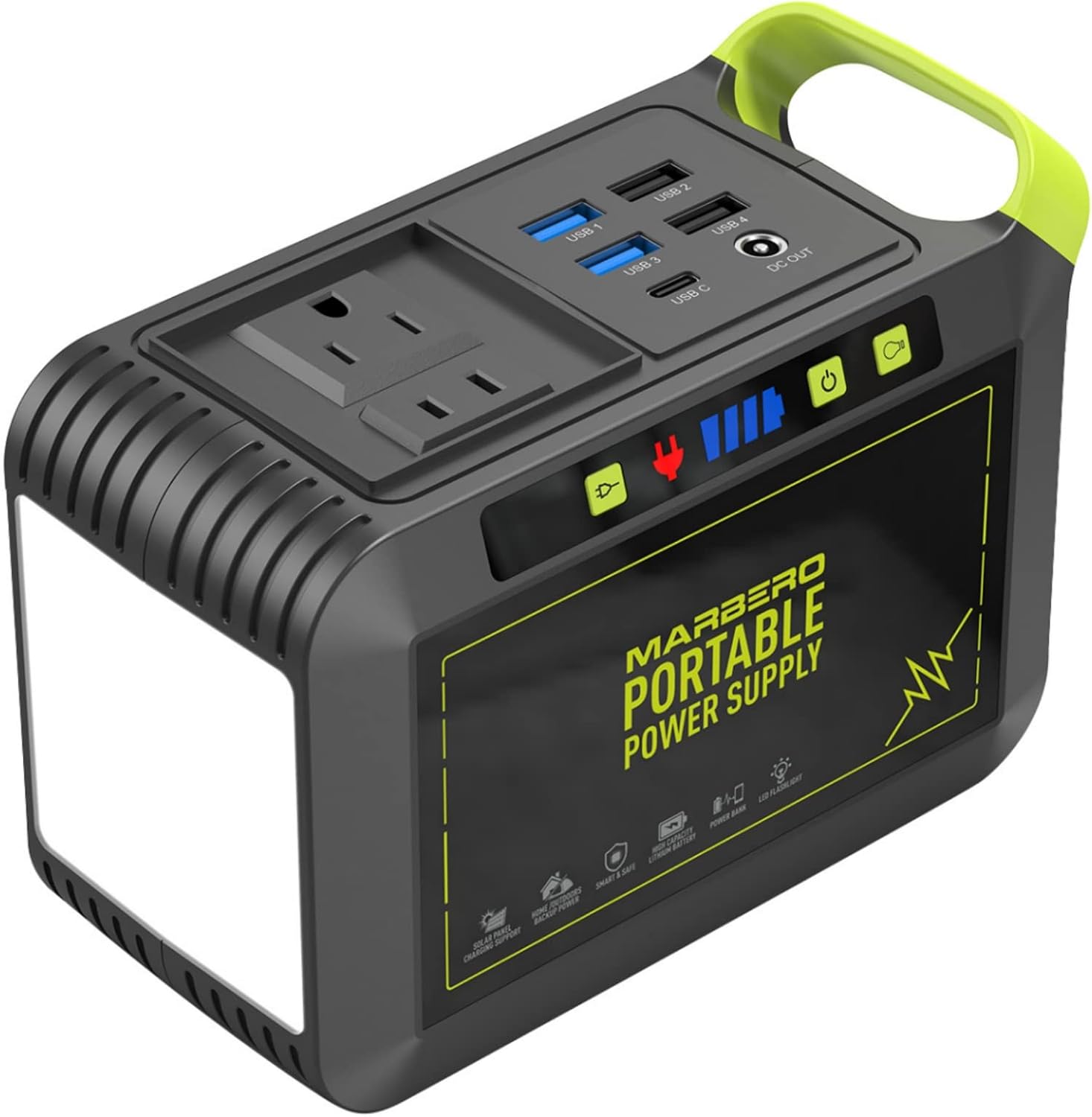
MARBERO Portable Power Station 88Wh, 120W Surge
Cheapest way to keep a phone, a tablet, and a laptop alive through a two-day outage. The stated 24,000mAh works out to roughly 88Wh, so the capacity claim and the name actually agree.
120W is a surge number with no sustained rating published next to it. Anything with a motor or a heating element is off the table.
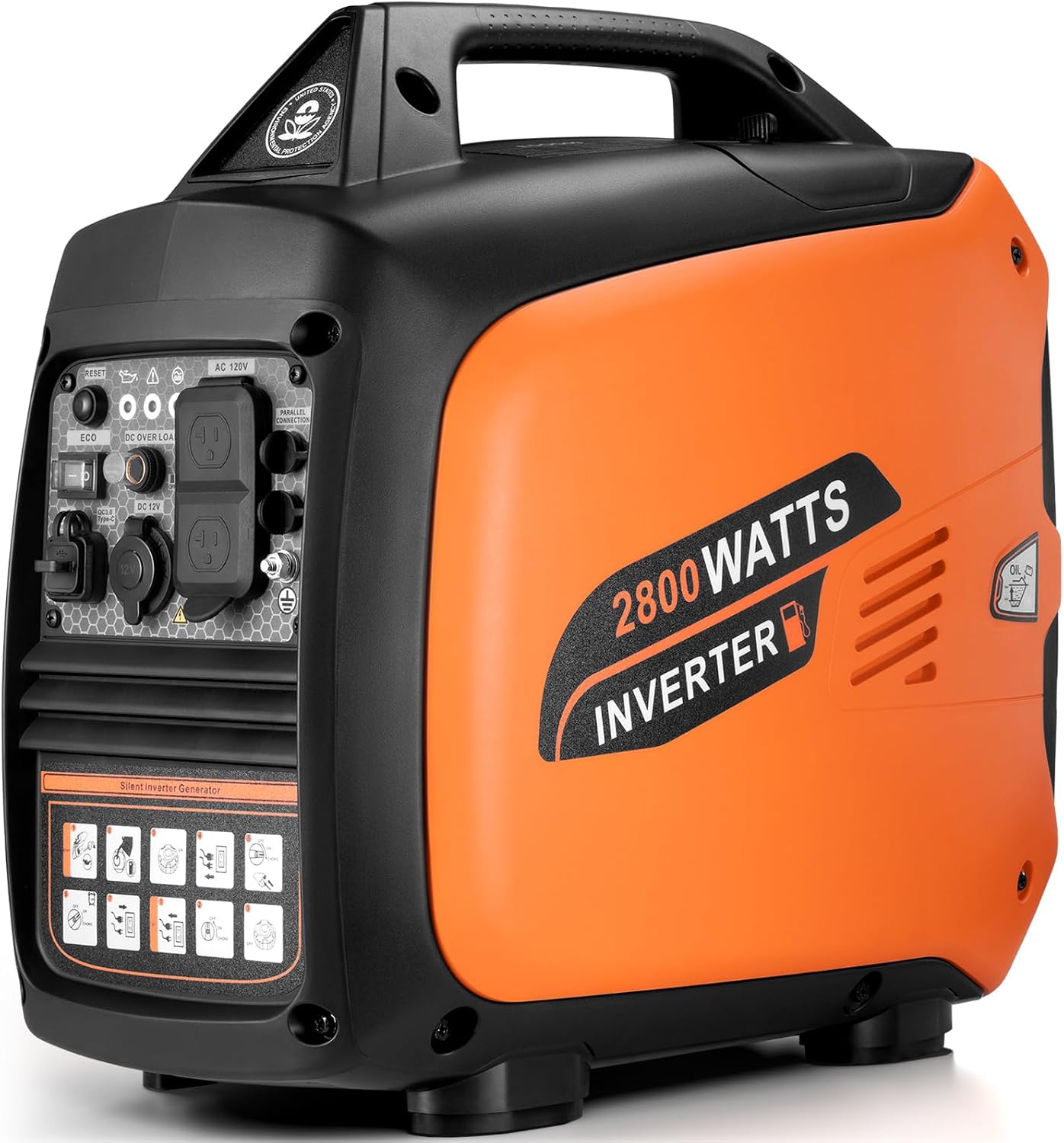
Oxseryn 2800-Watts Portable Inverter Generator
Runtime is limited by the 1.1 gallon tank, not by a battery gauge. It will run a refrigerator, a furnace blower, or a well pump, which no battery unit in this lineup will.
39 pounds dry, plus fuel. Needs oil, fuel, storage discipline, exhaust clearance, and a carbon monoxide plan. It is a machine, not an appliance.
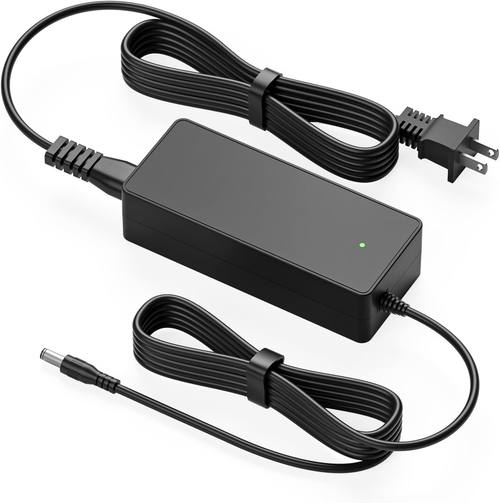
Charger for Jackery, 24V 90W AC Adapter for Explorer 160/240/300/500/550 and E300/E500/E550
Restores full wall charging speed on an Explorer you already own, for far less than a new station. It covers a wide spread of models, from 167Wh up to 518Wh.
It stores nothing. It only helps if a Jackery is already sitting in your garage, and it does nothing for any other brand.
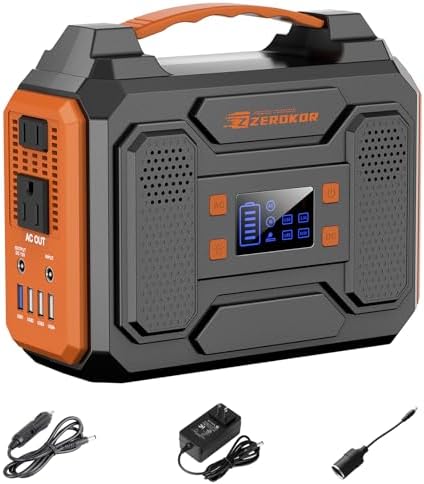
Portable Solar Generator 300W Portable Power Station with 60W Solar Panel
Inverter and panel ship together, so there is no connector mismatch to solve and no separate purchase to forget. The 60W panel is honestly matched to a station of this size.
The name leads with the 300W inverter and never states battery capacity, which is the number that decides how long anything actually runs.
Prices and availability were captured from Amazon Creators API and may change.
Watt-hours, not watts: the math that decides everything
Here is the arithmetic I run before I look at anything else.
The MARBERO lists 24,000mAh. At a nominal 3.7 volts per cell, that is about 88.8 watt-hours, which is why the product name says 88Wh. Those two numbers agree with each other, and that agreement is a good sign. Plenty of listings do not agree, and when they do not, the milliamp-hour figure is almost always the inflated one, because it looks bigger.
The Jackery adapter lists 90 watts at 24 volts. If you are charging a 518Wh Explorer 500 class unit, 90 watts gets you from empty to full in a little under six hours on paper, and realistically a bit longer once you account for charging losses and the tail end of the charge curve where current tapers off. That is the number that matters, because the original low-wattage bricks on these units turn a two hour job into an overnight one.
The Oxseryn does not have a watt-hour figure at all, and it should not. Its runtime is a function of a 1.1 gallon tank and whatever load you hang on it. That is a completely different equation, and it is why the gas unit is in a separate category from the other three.
And the 300W solar bundle? I can tell you the inverter rating from the name. I cannot tell you the battery capacity from the name, and neither can anyone else reading that listing. That is the first thing to check before buying, because a 300W inverter pushing a small battery runs out fast, and a 300W inverter pushing a large one runs for hours.
MARBERO 88Wh: the phone and laptop unit
This is the category I recommend to about half the people who ask me what to buy. Not because it is impressive, but because it matches the real load. A phone is roughly 15Wh. A laptop is 50 to 70Wh. A LED lamp is under 10W. An 88Wh station covers a night of that comfortably and a second night if you are disciplined.
What I do not like is the 120W surge figure with no sustained rating printed beside it. Surge ratings are the oldest trick in this industry. A unit that surges to 120W might sustain 100W, or it might sustain 60W. If the sustained number is not published, you find out by tripping the inverter. For a phone charger that is a minor annoyance. For anything with a compressor or a motor, it is a hard no.
Where it wins is weight and simplicity. It sits on a shelf, it charges from a wall outlet or a car socket, and it does not need fuel, oil, or ventilation. If your outage plan is "keep the phones alive and the router running so I can work," this is the correct purchase and the rest of this article is not for you.
The 300W solar generator with a 60W panel
This one is the middle child, and it is the one I would push most people toward if they want a single box that does more than charge phones.
A 300W inverter is a real step up. It will run a laptop, a monitor, a router, a fan, a small TV, and a string of lights at the same time without breaking a sweat. It will not run a space heater, a microwave, or a coffee maker, and anyone who tells you otherwise is selling something.
The 60W panel is the part I want to talk about, because solar bundles are where the math usually goes bad. A 60W panel is small. On a good day, angled properly, in full sun with no shade, you might see something in the neighborhood of 45 to 50W actually reaching the battery. That is a trickle, not a solution. It is enough to keep a small station topped up over a weekend of camping, and it is not enough to recharge a depleted station in an afternoon. Treat the panel as a bonus that extends a trip, not as a power plant.
The advantage of buying them together is fit. Proprietary solar connectors are one of my least favorite things in this hobby, and a matched bundle sidesteps the whole adapter hunt. You unbox it, you plug the panel into the station, and it works.
The thing to verify before you buy is capacity. The listing name gives you the inverter size and the panel size and stops there. Battery capacity is the number that determines runtime, and you should find it and read it before you commit.
Oxseryn 2800W: the fuel burner
I have a bias here and I will state it up front. I think gas generators are for construction sites, and for the narrow set of homeowners who need to carry a whole-house load for days. Everyone else is better served by a battery and a plan.
That said, if you are in that narrow set, this is the class of machine that does the job. 2800 watts runs a refrigerator, a furnace blower, a sump pump, or a well pump. It runs them for as long as you keep pouring fuel into a 1.1 gallon tank. There is no state of charge to watch, no inverter to trip, and no charge cycle to think about. It also ships EPA compliant with a fuel shut off, which is the feature you want so the carburetor does not varnish itself into a paperweight between outages.
The costs are real. It weighs 39 pounds before you add fuel, so it is a two hand carry or a wheeled cart. It needs oil changes, fuel stabilization, and a run every few months whether you need it or not. It is loud. It produces carbon monoxide, which means it never goes inside a garage, a van, or a tent, and it needs to sit well away from windows and intake vents.
For a van build or a camping setup, it is the wrong tool. For a rural property with a well pump and a multi-day outage, it is the only tool in this lineup that actually works.
The Jackery 24V 90W AC adapter
This is the most misunderstood product in the group, so let me be blunt. It is not a power station. It stores nothing. It is a charging brick.
What it does is restore the fast wall charging that a lot of older Explorer units lose when the original adapter fails, gets lost in a move, or gets borrowed and never returned. It is rated 24 volts at 90 watts and it covers the Explorer 160, 240, 300, 500, and 550, plus the E300, E500, and E550, which spans 167Wh up to 518Wh. If you own one of those and you have been charging it from a USB port or a 12 volt socket, you have been living with charge times that are three to five times longer than necessary.
Buy it if a Jackery is already in your closet and the charging situation is slow or broken. Skip it if you own anything else, because it does nothing for other brands, and skip it if you do not own a station at all, because a charging cable with nothing to charge is just a cable.
The trade-offs, stated plainly
Battery units are silent, zero maintenance, and safe indoors. They are also finite. Every watt-hour you pull out is one you have to put back, and putting it back takes hours.
The gas unit is effectively infinite within its fuel supply and it is loud, heavy, and requires actual ownership. Fuel goes bad. Carburetors clog. It has to be exercised. In exchange, it runs loads that no battery in this lineup will touch.
Solar is the weakest link in any bundle. A 60W panel is a maintenance charger for a small station, not a replacement for a wall outlet. If you are choosing between spending more on battery capacity and spending more on panels, buy the battery. You can always add a panel later, and the battery is what keeps the lights on at 2 a.m.
Which one fits which job
If your outage plan is phones, laptops, a router, and a couple of lamps, buy the MARBERO and stop reading. It is the smallest correct answer.
If you want one box that runs a laptop, a fan, and lights, and you want to top it up from the sun while camping, the 300W solar bundle is the pick, provided you verify the battery capacity before you check out.
If you own an Explorer 160 through 550 and charging has become an overnight event, the 24V 90W adapter is the cheapest fix in this entire article.
If you need a refrigerator, a furnace blower, a well pump, or a sump pump to run through a multi-day outage, none of the battery units here will do it, and the Oxseryn is the one that will.
Bottom line
Two of these four products are power stations, one is a generator, and one is a cord. That is not a flaw in the lineup, it is an accurate picture of what people actually buy when the grid gets unreliable. Size the battery to the load you can name, not the load you imagine, and be honest about whether you are willing to store fuel and maintain an engine. If you are not, a battery unit and a wall outlet will cover more of your life than you think.