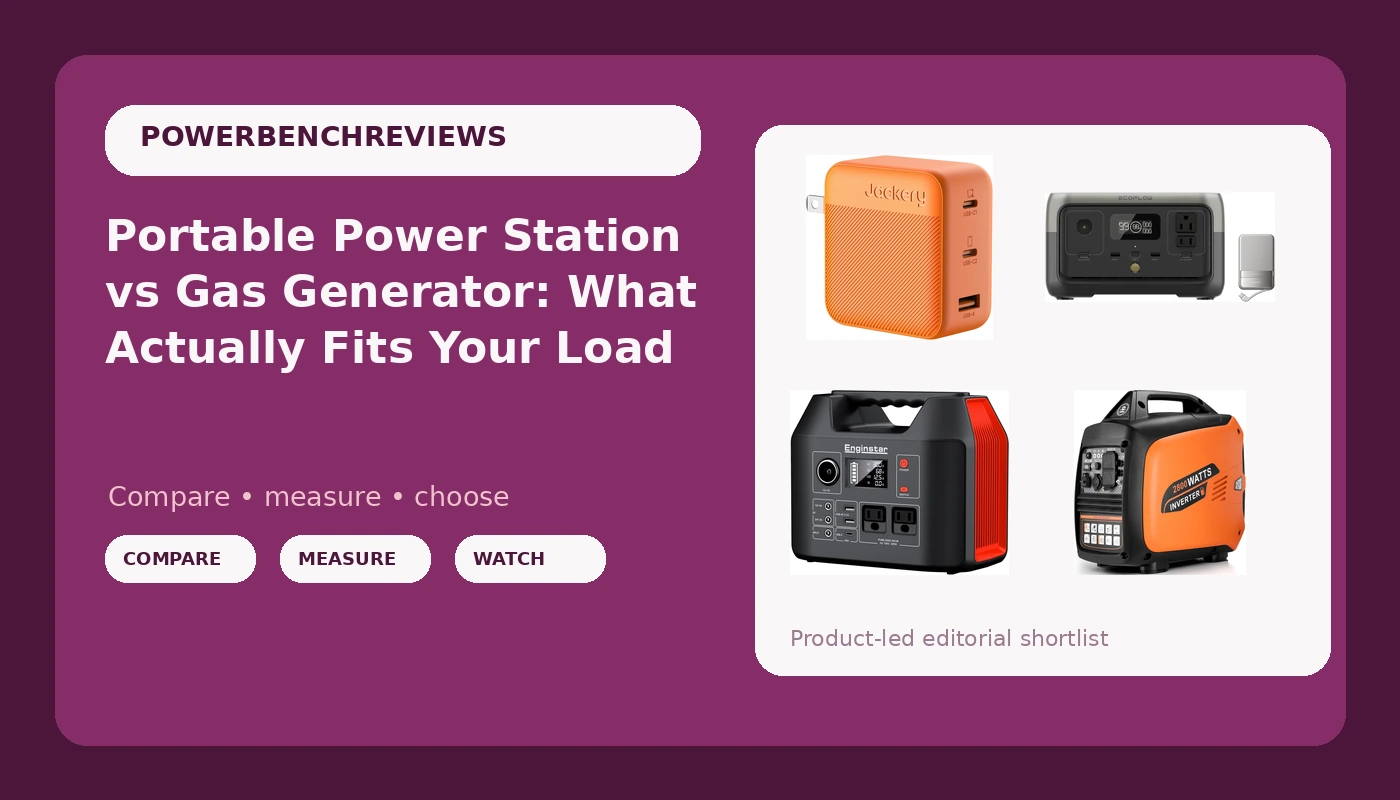
The portable power station vs gas generator question shows up in my inbox every time a storm takes the grid down for three days. The mistake almost everyone makes is shopping by watts first. Watts tell you what a unit can run at one instant. Watt-hours tell you how long it can keep running, and that load math is what actually decides whether a 296Wh box or a 2800 watt inverter generator belongs in your garage. This explainer covers four options that span the range, from a solar-ready station you can carry in one hand to a small gas inverter generator, and it shows you how to choose based on the load you really have rather than the biggest number on a box.
Related: How to Size a Power Station to Your Real Load →
Quick answer
For light loads, a battery station is the simpler choice. Phones, laptops, LED lights, a router, and a small fan all sit inside a 296Wh to 300Wh class unit. For heavy or long-running loads, such as a fridge, a sump pump, or a space heater through a cold night, a small gas inverter generator runs far longer on a tank of fuel, but it needs ventilation, fuel storage, and outdoor placement. The Jackery charger here is not a station at all. It is a fast-charging accessory. Add up your watt-hours first, then pick the box.
Four useful options
| Model | Best fit | What stands out |
|---|---|---|
| EnginStar Portable Power Station 300W 296Wh Solar Generator | Light loads, tent and van camping | 300W output with a 296Wh battery and a solar generator design |
| Jackery 102W GaN 3-Port Fast Charger, Dual 100W USB-C & 18W USB-A Ports, Quick Charging with PD3.0, PPS, QC4.0, Compatible with Jackery Explorer 100Plus/240v2/300Plus | Charging USB-C laptops and compatible Jackery stations | 102W GaN, dual 100W USB-C, 18W USB-A, PD3.0, PPS, QC4.0 |
| EF ECOFLOW Power Bank + Power Station RIVER 2 | Everyday carry power that also runs small AC loads | Listed as a power bank and a power station in one unit |
| Oxseryn 2800-Watts Portable Inverter Generator, Gas Generators for Home Use, Camping, Super Quiet Emergency Home Backup, with Fuel Shut Off, 1.1Gal Fuel Tank, 39Lbs, EPA Compliant | Long outages and heavy loads | 2800 watts, fuel shut off, 1.1 gallon tank, 39 lbs, EPA compliant |
Compact station for light loads: EnginStar Portable Power Station 300W 296Wh Solar Generator
The 296Wh figure is the number that decides your night. Divide it by your load and account for inverter losses, and a 100W draw lands somewhere near two and a half hours, while a 50W draw stretches closer to five. That is a laptop and a light, or a small fan running while you sleep, not a space heater and not a full-size fridge compressor starting up. The 300W rating is the other limit worth respecting: surge behavior on motor loads is not the same as a steady resistive load, and compressors and pumps are where small stations get tripped. As a first station for camping, tailgating, or keeping phones and a router alive through an evening outage, this class does the job without weighing you down.
Fast charging companion: Jackery 102W GaN 3-Port Fast Charger
This one is easy to misread, so here is the trade-off plainly. It stores no energy. During an outage it does nothing on its own, because it needs a wall outlet or another power source feeding it. What it does well is move power quickly: 100W over USB-C is enough to run most modern laptops at full speed, and the listed compatibility with the Jackery Explorer 100Plus, 240v2, and 300Plus means it can top those units back up from a wall outlet faster than a standard phone brick. If your station is your battery and your charger is your bottleneck, this is the cheap fix. If you are looking for the battery itself, keep reading.
Everyday carry station: EF ECOFLOW Power Bank + Power Station RIVER 2
The honest trade-off with any dual-identity unit is that it is a compromise in both directions. It will not run a fridge, and it will not run a space heater, and you should not plan a multi-day outage around it. What it will do is live in a bag without complaint, charge the devices you carry, and give you a real AC outlet when you are far from one. For commuters, photographers, and people who want one box instead of a battery and a separate travel brick, that combination is the point. Buy it for the everyday carry role and treat the AC outlet as a bonus, not as a backup power plan.
Fuel backup for long outages: Oxseryn 2800-Watts Portable Inverter Generator
Here is where the two technologies split cleanly. A 1.1 gallon tank on a 2800 watt inverter unit will outlast any battery in this article by a wide margin, and refueling resets the clock. The price you pay is operational: it has to run outdoors, well away from windows, doors, and vents, because exhaust is carbon monoxide. It needs fresh fuel, stabilizer, and oil changes. It is heavier than the stations here and it does not run silently, whatever the listing copy says. Inverter output does mean cleaner power for sensitive electronics than a conventional generator, which matters for laptops and routers. For multi-day outages and construction sites, fuel still wins on endurance.
Prices and availability may change. Product images, names, and retailer links are matched to verified listings. No current price, rating, stock status, or measured result is stated here without current evidence.
Watts and watt-hours: the math that sizes the whole setup
Watts are a rate. Watt-hours are a quantity. A 296Wh battery is a bucket, and every load you plug in is a hole draining it. To estimate runtime, add up the wattage of everything you plan to run at once, multiply by the hours you need, and compare that total against the capacity on the label. A 60W laptop for four hours is 240Wh before losses. Add a 10W light for six hours and you are at 300Wh, which is already past a 296Wh unit once inverter overhead is included. Inverter losses are real, and a useful planning figure is to treat roughly 10 to 15 percent of your stored energy as unavailable. If your total lands near or above the capacity you are considering, you have two honest options: drop loads, or move up in class.
Battery or fuel: what each one costs you in practice
Battery stations are quiet, fume-free, and safe to run indoors, which is why they handle bedrooms, apartments, and van interiors where a gas unit simply cannot go. They also need no maintenance beyond keeping them charged, and they can be recharged from a wall outlet, a car, or solar panels. Their limits are capacity and recharge time. Gas inverter generators are the opposite: enormous energy density per pound of fuel, instant refueling, and no dependency on the grid, at the cost of noise, exhaust, fuel handling, and periodic maintenance. Most households that take outages seriously end up with both, using the station for overnight and indoor loads and the generator to run the big appliances during the day while recharging the station.
- List every device you want to run and its wattage, taken from its own label rather than from memory.
- Estimate the hours per day you need each one, then multiply to get watt-hours per device.
- Add the devices you will run at the same time to find your peak wattage, since that is what trips an inverter.
- Compare the watt-hour total against the capacity of the station you are considering, adding 10 to 15 percent for inverter losses.
- If the total exceeds a station's capacity by more than a small margin, price out a fuel generator or plan to shed loads.
Practical guidance before you buy
- Measure your real loads once with a plug-in meter, because nameplate wattage and actual draw often disagree.
- Check surge behavior on motor loads, since a fridge or pump can pull several times its running wattage at startup.
- Keep a gas unit outdoors and away from windows and vents, and never run one in a garage attached to the house.
- Store fuel properly with stabilizer, and use the fuel shut off to run the carburetor dry before long storage.
- Recharge battery stations to a partial state rather than full if they will sit unused for months, and top them up before storm season.
Which option should you choose?
Choose the EnginStar Portable Power Station 300W 296Wh Solar Generator when your loads are lights, laptops, phones, and small fans, and you want a solar-capable station you can carry. Choose the Jackery 102W GaN 3-Port Fast Charger when your station or your laptop is fine but your charging speed is the bottleneck. Choose the EF ECOFLOW Power Bank + Power Station RIVER 2 when you want one portable unit for daily carry that also offers an AC outlet. Choose the Oxseryn 2800-Watts Portable Inverter Generator when you need to run heavy appliances for days and can run the unit outdoors.
Every capacity, wattage, and port figure quoted above comes from the manufacturer's listing for each product. Spec sheets are a promise, not a measurement, and the only way to know your real runtime is to run your own load against your own meter. Treat the arithmetic in this article as a planning estimate rather than a test result, and check the current listing before you buy.
The bottom line
The right answer depends on duration and location, not on which technology sounds more modern. For hours of light loads indoors, a battery station in the 296Wh class is the clean, quiet solution, and a fast GaN charger keeps its weak point from being recharge speed. For a compact carry unit that doubles as an outlet, the RIVER 2 fits that role. For outages measured in days and loads measured in kilowatts, a gas inverter generator with a fuel shut off and a real tank is still the only thing that keeps running after the batteries are spent. Size the load first, then buy the box that matches it.