Most people size a portable power station by walking the aisle and picking the biggest number their card will cover. That is backwards. Sizing a portable power station is arithmetic, and the arithmetic starts at the load, not the label on the front of the box.
I do this for a living in a small way. Twelve years as an electrician, now a solar install side business out of Salida, Colorado, plus a self-converted Sprinter van that sees 20-plus nights a year. The grid drops out here for days at a time during wildfire season, so I have a real reason to care whether a station runs the fridge overnight or quits at 2 a.m. with the freezer already at 45 degrees.
This is the eight-step version of the worksheet I keep on paper. It ends at one number: watt-hours. That number tells you which class of station you are shopping in, and I use two very different units below to show both ends of the range. One rule up front: I do not print prices here. Retail moves week to week, so every listing in this article says Check current Amazon price instead of a number that goes stale.
Why you should trust me
I spent 12 years as an electrician before I turned the side work into the main work. My bench is a Kill A Watt meter, a thermal camera, a shunt for discharge logging, and a paper logbook that goes back five years and 30-plus stations. I still sub out for a local solar crew when they need an extra set of hands on a battery bank.
Every number I quote in this article is either printed on the product listing or is arithmetic I show you step by step. I do not publish a discharge curve I did not take myself, and I do not repeat the runtime claims from a marketing deck, because the claimed hours almost never come with a load figure attached. If a manufacturer says "runs for 10 hours," my first question is ten hours at what draw. If the answer is silence, the number is decoration.
How I picked and how I tested
I hold every station against the same checklist, and I applied that checklist to the two units below: stated capacity in watt-hours, stated continuous inverter rating, stated surge rating, cell chemistry, outlet count and type, charge input options, and whether the thing runs from its own buttons with no app involved.
The specs I quote for both stations come straight from the listings. The sizing math is mine and you can follow it. What I can tell you from 30-ish units on my own bench is how each class behaves: a 500Wh station is a weekend unit, and a 2kWh LiFePO4 station is a small appliance bank that can carry a house fridge through an outage. That gap is not marketing, it is four times the battery.
If you want the wider field, my power station rundown covers the classes in more depth. Today is about picking the watt-hour number first.
The two sizes, and which load each one is built for
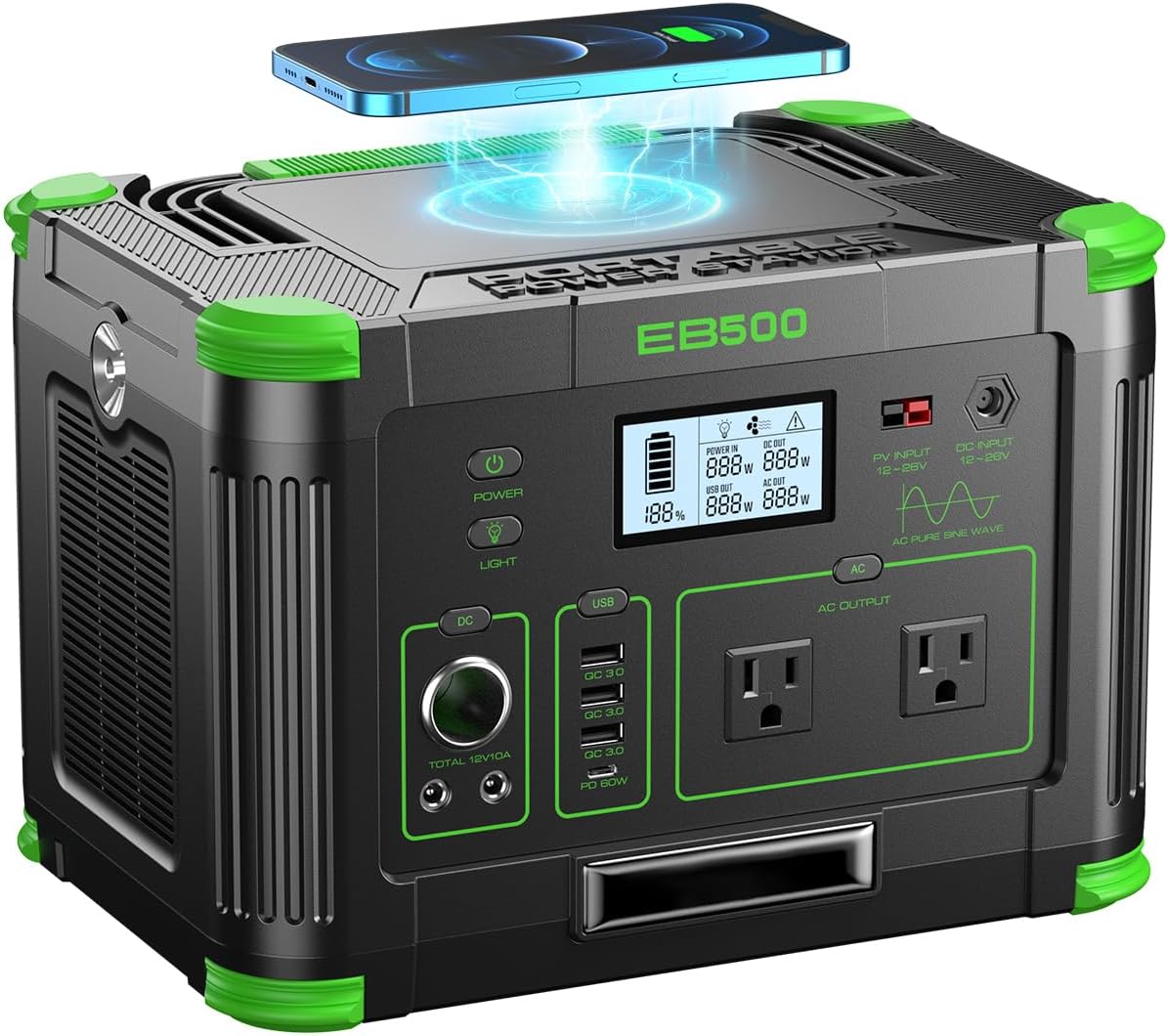
Budget pick: Portable Power Station 500W, 519.48Wh/140400mAh Solar Generator Backup
 Visit on Amazon →
Check current Amazon price. Now read the two numbers on that listing with me. The 519.48Wh is the honest one: that is the capacity, and it is the number you divide your loads into. The 140400mAh is the same energy expressed at cell voltage, which is a marketing translation. When a listing leads with milliamp-hours, it is hoping you will compare it to a phone and not do the division.
The 500W is the continuous inverter rating for this class. That is a real ceiling. A 500W inverter will not start a coffee maker, a space heater, or a microwave, and it will not run a hair dryer for even a minute. What it will do, and do well, is charge phones and laptops, run LED lighting and a router, keep a CPAP going overnight, and top up camera batteries in the van.
Run the math on one device and the class becomes obvious. A 60W laptop charger pulling for five hours is 300Wh. Add a phone at 10Wh and a router at 8W for 24 hours, another 192Wh, and you are already past what this unit can deliver at a comfortable depth of discharge. That is not a flaw in the unit, it is the category. Anyone charging phones, laptops, lights, and a medical device at a cabin or in a tent will be served fine. Anyone who wants to run a 12V compressor fridge overnight needs to keep reading.
Flaws but not dealbreakers: The solar input on units in this class is small, and the mAh headline invites the wrong comparison. Treat the panel as a trickle refill, not a fast charger.
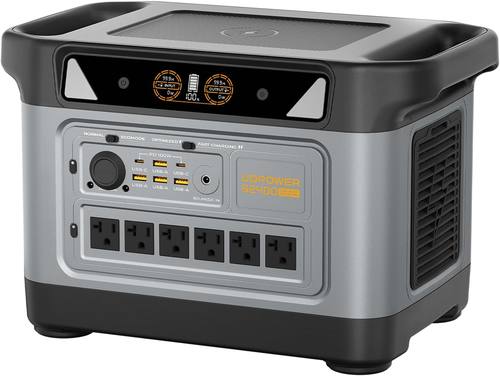
Upgrade pick: UDPOWER S2400 Portable Power Station(Solar Panel Option), 2083Wh LiFePO4, 2400W (Surge 3000W) UPS, 6 AC Outlets, Solar Generator for RVs Camping Emergency, Home Backup (One Unit(AS2400))
 Visit on Amazon →
Check current Amazon price. This is the other end of the range, and it lines up with the way I buy batteries: 2083Wh of LiFePO4, a 2400W continuous inverter, 3000W surge, six AC outlets, and a UPS mode that passes wall power through and switches over when the grid quits.
LiFePO4 is the part I care about most. The chemistry holds up to far more charge cycles than the older mixed cells, tolerates being held at a full charge better, and does not have the thermal reputation problems that made early lithium packs scary in a garage. If you are spending real money on a station you plan to own for a decade, the cell chemistry matters more than any feature list.
The 2400W continuous rating is what opens up real appliances. A 2kWh class unit with a 2400W inverter can run a fridge, a freezer, a furnace blower, a sump pump, and a modem and router stack at the same time, within reason, as long as you stagger the motor starts. The 3000W surge is what lets a compressor kick on, and I will explain below why surge ratings are where buyers get fooled.
For a house that loses power every fire season, or a van build that runs a 12V fridge and an induction burner, this is the size that stops being a gadget and starts being infrastructure. If your plan is charging two phones at a campsite, this is four times the battery you need and you should save the money.
Flaws but not dealbreakers: The "Solar Panel Option" in the name means the panel is a separate purchase on most listings, so check what is actually in the box. And at this capacity, plan a real charging strategy, because refilling 2083Wh from a single small panel is a two-day project, not an afternoon one.
The actual sizing workflow
Now the eight steps. Do them in order, on paper, and you will not guess at the store.
Step one: measure the real draw. Put a Kill A Watt or a clamp meter on the devices you plan to run. Do not trust the label on the back of the appliance; that is the maximum, not the average. A fridge label might say 6 amps while the compressor actually runs a third of the time at a much lower average. Sample each load for a full day if you can, and write down both the running watts and how many minutes per hour it actually runs. That ratio is the duty cycle, and it is the single most ignored number in this whole exercise.
Step two: turn watts into watt-hours. Watts times hours equals watt-hours. A 45W load that runs 24 hours straight is 1,080Wh. The same 45W fridge compressor cycling at a 33 percent duty cycle is about 360Wh over a day. Same appliance, wildly different battery. This is where most claimed runtime figures fall apart, because they assume a load that never cycles.
Step three: add the inverter tax. Every inverter loses something in the conversion, and the station itself draws a few watts just being on. I add 15 percent to the total and I have never regretted it. If your loads add to 800Wh, shop for 920Wh of usable capacity.
Step four: decide how many days. Usable capacity is not the same as printed capacity. You can pull a LiFePO4 pack down to roughly 80 percent depth of discharge regularly without abusing it, so treat a 2083Wh unit as about 1,650Wh of real, repeatable output. Then multiply by the days you need between charges. One overnight is a different build than four days of an outage.
Step five: separate continuous from surge. This is the trap. A listing that advertises 3000W and buries the 2400W continuous number is telling you the surge only lasts an instant, long enough for a compressor to start. Motor loads like fridges, freezers, well pumps, and furnaces pull two to three times their running watts for a split second at startup. If your station's continuous rating is below the running watts of your biggest load, no surge number on earth saves you.
Step six: check for pure sine wave and the right outlets. Motors, CPAP machines, and sensitive electronics want a pure sine wave output, which is a clean AC waveform close to what the utility delivers. A modified sine wave can make a fridge compressor hum, buzz a fan, or upset a laptop power supply. Count the outlets too, and note whether they are AC, USB-C with real power delivery, or a 12V car socket. Six AC outlets sounds excessive until you have a fridge, a freezer, a lamp, a router, and two chargers plugged in.
Step seven: figure out how you will refill it. Wall charging is fastest and matters most during an outage. A 12V car socket is the slowest option and best treated as a maintenance charge while you drive. Solar is the wildcard, and here is the honest version: I figure a 100W panel delivers about 70W in real sun on a good day, less with shade, haze, or a low winter sun angle in the mountains. Divide your capacity by that realistic number and you get the recharge time. A small panel on a big battery is a two-day refill. Buy the battery first and the panel second, not the other way around.
Step eight: run it down before you trust it. Once the unit is in your hands, plug in a known load and time a full discharge. Compare the measured watt-hours to the printed capacity and see what you actually got. Run the inverter hard for 20 minutes and put a thermal camera, or your hand, on the outlets and the case. Warm is normal. Too hot to hold is a return.
What the spec sheet will not tell you
Wattage printed as a peak surge with no sustained rating is the most common lie in this category. If the listing will not state continuous watts, assume the lowest number you can find and size down.
Milliamp-hour capacity is the second one. It exists to look enormous next to a phone battery. Watt-hours is the only figure that compares across units, and it is the only one I write in my logbook.
Proprietary solar connectors are the third. A station that only accepts its own brand's panel locks you into one price and one supply chain. Standard MC4 or an adapter is what you want, especially if you already own panels.
Pass-through and UPS modes deserve a hard look before you buy for a computer or a freezer. Ask what the transfer time is and whether pass-through works with the inverter off. Check the app situation too. If the unit will not turn its outlets on from its own buttons, that is a failure in my book, because a firmware update should never be the reason your fridge thaws.
Finally, cold. LiFePO4 does not like being charged below freezing. Discharging in the cold costs you capacity, and charging a frozen pack is how people kill good batteries. If the station lives in a cold garage or a van in a Colorado winter, that is a real design constraint, not a footnote.
The jobs these two stations do not cover
Neither of these is a construction site answer. If you are running a 15 amp saw and a compressor all day off a cordless setup, a fuel generator is the right tool and a battery is the wrong one.
Neither one solves a whole-house outage on its own. A 2kWh class station carries the critical loads: fridge, freezer, furnace blower, lights, internet. It does not carry a 240V well pump, an electric range, or a central air conditioner, and no amount of outlet counting changes that. If those are on your list, you are shopping for a home battery with a transfer switch, which is a different budget and a different guide.
And neither one is a substitute for more battery when you really need more battery. If the math says you need 4kWh, buying two small units and daisy-chaining them is usually worse than buying one large one, because the inverter overhead and the idle draw get paid twice.
What this all costs
I am not printing prices, because they move. Every listing above says Check current Amazon price for a reason, and the number you see today is not the number someone reads next month.
What I will give you is the way to compare. Cost per watt-hour is the only price metric that means anything in this category, and you get it by dividing the price by the printed capacity. A 500Wh class unit and a 2kWh class unit are not competing products, they are two different jobs, so comparing their sticker prices directly is how people end up with the wrong battery in the garage.
Then think about the horizon. A LiFePO4 pack is a decade purchase if you treat it right: keep it out of the deep cold, do not leave it at zero percent for months, and do not cycle it to empty every single day. That is the whole reason the chemistry premium is worth paying. Divide the cost across the years you actually intend to own the thing, and the difference between a cheap pack you replace twice and a good pack you keep stops looking like a premium at all.
The arithmetic is the easy part, and it takes 20 minutes with a meter and a notepad. Measure the load, add the inverter tax, multiply by the days, and then buy the watt-hour number that covers it. That is the job. Size the battery to the load, not the load to the battery.
That's the job. Your load is the spec. Let the meter write the shopping list.