Related: How to Size a Power Station to Your Real Load
A 2400W portable power station is the size where the marketing stops mattering and the math takes over. I am Dan. I spent 12 years as an electrician before I started installing solar and writing about power gear from a mountain town in Colorado, where the grid drops for days every wildfire season. I keep a Kill A Watt meter, a thermal camera, and a paper logbook on the bench. A spec sheet is a promise. The meter is the truth.
That matters here, because all four units in this guide sit in the same neighborhood: 2,400W inverters, roughly 1,800 to 2,100 watt-hours of storage, and price tags that span a wide gap. The differences that decide your purchase are not the headline watts. They are the chemistry, the surge rating, the outlet count, whether the unit behaves like a UPS, and whether you are paying for solar panels you may not need.
So treat this as a sizing guide first and a shopping list second. Here is how I think about a 2400W portable power station, and which of these four I would hand to which person.
The 2,083Wh anchor: UDPOWER S2400, one unit
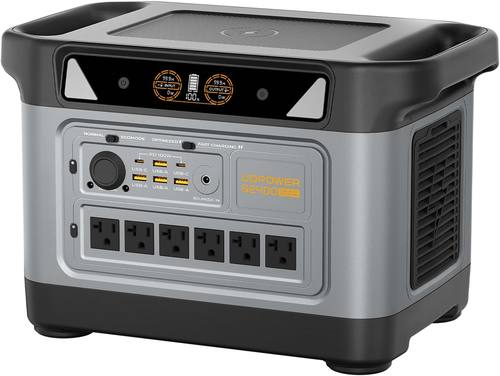
This is the unit I would start with if the job is keeping a house alive during an outage. The numbers on the listing are the ones that matter: 2,083Wh of LiFePO4, 2,400W continuous, 3,000W surge, six AC outlets, and a UPS function.
Start with the chemistry, because it is the decision that outlasts everything else on the page. LiFePO4 costs more up front and gives you more usable cycles and a deeper usable depth of discharge than the older lithium blends. If you plan to discharge this thing 200 nights a year for the next decade, chemistry is the spec that decides whether you bought a tool or a subscription to replacement batteries. That is why I say LiFePO4 or nothing in this class.
Then the inverter. A 2,400W continuous rating with a 3,000W surge is a real number, not a marketing number, and it is the reason this class exists at all. It means a refrigerator can start. It means a furnace blower can run. It means a 1,500W space heater is possible but wasteful, because a resistive heater burns watt-hours faster than anything else in your house.
Six AC outlets is the quiet feature nobody advertises. Six outlets means you do not need a power strip hanging off the front of the unit, which means fewer connections to knock loose at 2 a.m.
And the UPS mode is the part people underestimate. Pass-through power means the station sits between the wall and your equipment, runs off the wall when the grid is up, and takes over when it drops. That is a different product than a camping box, and it is the reason this one earns the top slot.
The bundle math: UDPOWER S2400 with the 210W panel
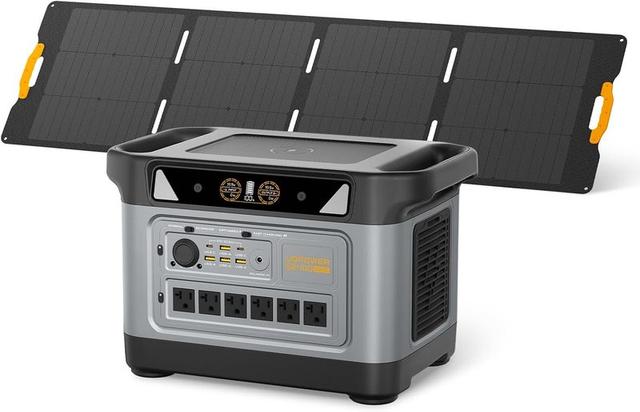
Same station, same 2,083Wh of LiFePO4, same 2,400W inverter with the 3,000W surge and six outlets. The difference is the 210W panel in the box.
Here is the math you should do before you pay for the bundle. A 210W panel, in perfect sun, at perfect angle, with no cloud and no heat derating, is a 210W panel. Real conditions give you less. So recharging 2,083Wh from empty is a long day of good sun, not an afternoon. Panels are the weakest link in every solar bundle I have ever looked at, and the watts per dollar almost always favor buying more battery instead of more panel.
That said, there is a legitimate case for the bundle. If you want one order, one box, one set of connectors that already match, and you are charging at a campsite or a job site with no outlet, the bundle is the path of least friction. My rule is simple: buy the battery you need first, then add panels once you know how you actually use the thing. If you already own a panel, buy the one-unit version and put the savings into a second battery later.
Either way, check the listing rather than guessing, since bundle pricing moves.
The value pick: 2,400W Portable Power Station, 1,843.2Wh
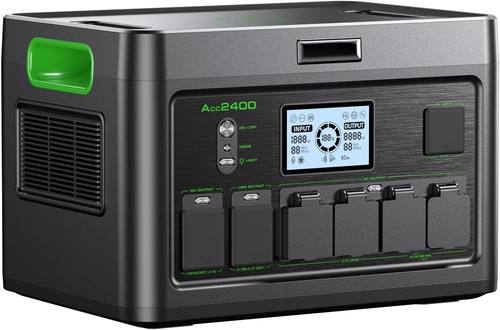
Same inverter class, less battery: 2,400W output and 1,843.2Wh of storage, aimed at home use and outages. This is the unit I would point a first-time buyer toward.
The trade is about 240Wh. Put that in human terms instead of spec-sheet terms. A 240Wh difference is roughly an hour of a 240W load, or a couple of laptop charges, or a few more hours of a router and a light. It is real, and it is not the difference between a working outage and a failed one. If you are running a fridge, a modem, lights, and phone chargers through an evening, both stations cover it. If you are running a furnace blower all night in February, you want every watt-hour you can get, and you should size up.
Where this unit wins is the same place most buyers actually live: one box, one price, enough inverter to start a compressor, and enough storage to matter. It is the sensible answer for a van, a cabin weekend, a tailgate, or a first outage kit. If the math says you need more, you will know after one season, and by then you will also know whether you want a second station or a bigger one.
The expandable pick: Jackery HomePower 1000 Plus v2 with Battery Pack 2000
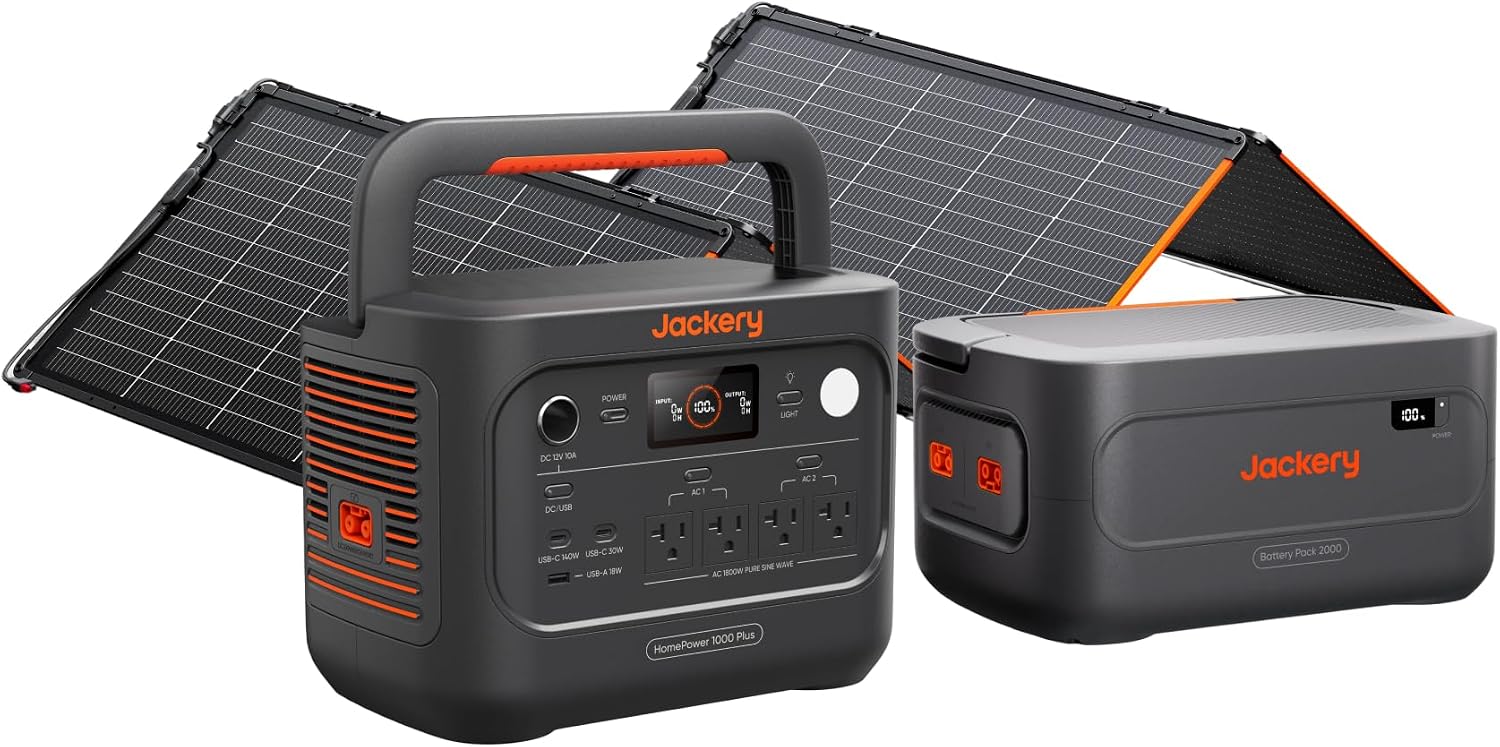
This one is a system, not a box. The listing pairs the HomePower 1000 Plus v2 with a Battery Pack 2000 and a 340Wx panel, which is the modular route: a smaller head unit, an expansion battery that stacks on, and a panel on top of that.
Modular has a real advantage. You can buy the head unit now and add capacity later without replacing the inverter. For a home backup setup you intend to grow, that is a smarter shape than a single sealed box, because the inverter and the battery have different lifespans. The inverter usually outlives the cells.
The trade is price and ecosystem. Jackery made this market and then coasted while the competition caught up, and that shows up in two places: the cost per watt-hour, and the connectors. Proprietary solar connectors are one of my pet peeves, because they lock you into one brand's panels. If you already own panels with standard connectors, that is a real cost on top of the purchase.
So the honest read: buy this if you want a name you know, an app that works, and a path to adding a battery pack later. Do not buy it expecting the best watts per dollar in the class, because it is not that.
The reference table
This is the table I keep taped inside the shop cabinet. Same four units, same numbers pulled from their own listings. Nothing here is a measured value, and nothing here is a current price, so click through and check the listing yourself before you commit.
| Model | Storage | Inverter | Best for | Price |
|---|---|---|---|---|
 Visit on Amazon → UDPOWER S2400, one unit |
2,083Wh LiFePO4 | 2,400W, 3,000W surge, 6 AC outlets, UPS | Whole-home basics, RV hookups, pass-through UPS duty | $699.99 |
 Visit on Amazon → UDPOWER S2400 with 210W panel |
2,083Wh LiFePO4 | 2,400W, 3,000W surge, 6 AC outlets, UPS | Off-grid charging where there is no wall outlet | $949.99 |
 Visit on Amazon → 2400W station, 1,843.2Wh |
1,843.2Wh | 2,400W | First station, van life, outage kit on a budget | $499.99 |
 Visit on Amazon → Jackery HomePower 1000 Plus v2 system |
Head unit plus Battery Pack 2000 | HomePower 1000 Plus v2 inverter | Growing a home backup system over time | $3,299.00 |
How I bench test a station before it gets a recommendation
Every station that gets my name on it goes through the same routine. No exceptions, no shortcuts, and no unit that skips a step.
First, the load. I put a known resistive load on the inverter and read it with the Kill A Watt meter, because the display on the front of the unit is a convenience, not an instrument. Then I add a motor load, because a compressor start is where weak inverters fall over, and the surge rating is the number that decides whether your fridge runs.
Second, the discharge. I run it from full to empty at least three times and log the numbers in the paper logbook. One discharge tells you almost nothing. Three tells you whether the cells are behaving and whether the low-battery cutoff is where the manual claims.
Third, the thermal pass. I point the thermal camera at the inverter section and the fan exhaust under sustained load. A station that screams at 200W is a station that will annoy you for years, and heat is the thing that kills cells quietly.
Fourth, the buttons. I unplug the app and run everything from the unit itself. If a station cannot start, stop, and switch modes from its own controls, it fails my bench, because an app is a feature and not the product.
Fifth, the sine wave. I check the output on a meter. Pure sine wave matters for anything with a motor or a sensitive power supply, and it is the first thing I verify when a listing leads with wattage and says nothing about waveform.
What the numbers actually mean when you are shopping
Watt-hours over watts. Every time. The wattage rating tells you what the inverter can push out the door at one instant. The watt-hour rating tells you how long it can keep pushing. A 2,400W inverter with a small battery is a sprinter with a thimble of water.
Do the load math before you shop. Add up what you actually want to run, multiply the watts by the hours, and compare that number to the storage. A fridge does not run continuously, so its real draw over eight hours is far less than its nameplate. A space heater does run continuously, and it will empty 2,000Wh faster than anything else you own.
Surge versus continuous. If a listing leads with a surge number and never states a sustained rating, walk away. Continuous is the number you live with.
Depth of discharge. You do not get to use every watt-hour a battery holds without paying for it in cycles. LiFePO4 lets you go deeper without hurting the pack, which is why the same nominal capacity behaves differently across chemistries.
Panels are a bonus, not a religion. Most people are better off buying more battery than more panel, and the bundle math in this class usually proves it.
Should you buy the UDPOWER S2400?
Yes, if you want one box that covers a real outage. The 2,083Wh of LiFePO4, the 2,400W continuous inverter with a 3,000W surge, the six outlets, and the UPS pass-through mode are the four things that matter in this class, and it has all four. Buy the one-unit version if you already own panels. Buy the bundle if you do not, and accept that the panel is the slow part of the system.
Should you buy the 2,400W, 1,843.2Wh station?
Yes, for most first-time buyers. It is the value pick here, and the roughly 240Wh you give up against the S2400 is not the difference between a comfortable night and a cold one for normal outage loads. If you are running a furnace blower through a February night, size up. If you are running a fridge, a router, lights, and chargers, this is the sensible place to start.
Should you buy the Jackery HomePower 1000 Plus v2 system?
Only if you want the expandable path. The pairing of the head unit with the Battery Pack 2000 and the 340Wx panel is a genuine advantage for a system you plan to grow, because the inverter outlives the cells. But you pay for the name, you live with Jackery's connectors, and the watts per dollar favor the UDPOWER units. Buy it for the ecosystem. Do not buy it for the value.