I’ve been testing the Anker SOLIX line for about 18 months now, and I have to say, their marketing team is doing heavy lifting. Anker sells these on "premium design" and a slick app, but after running the C1000 and the F3800 on my bench, and living with the smaller units in my Sprinter, I’ve found that the real story is the LiFePO4 battery chemistry and the serviceability.
Is the SOLIX line the "engineering dark horse" of the portable power world? A bit. But you need to know where they cut corners.
Here’s the truth after a year and a half.

Anker SOLIX C1000 + Expansion Battery
2,112Wh total capacity, 1,800W output, and the expansion battery doubles your runtime for less...
Visit on Amazon →
Anker SOLIX F3800 Plus Portable Power Station+ 400W Solar Panel【NEW】
3,840Wh LiFePO4 station with up to 400W solar input and 26.9kWh expansion.
Visit on Amazon →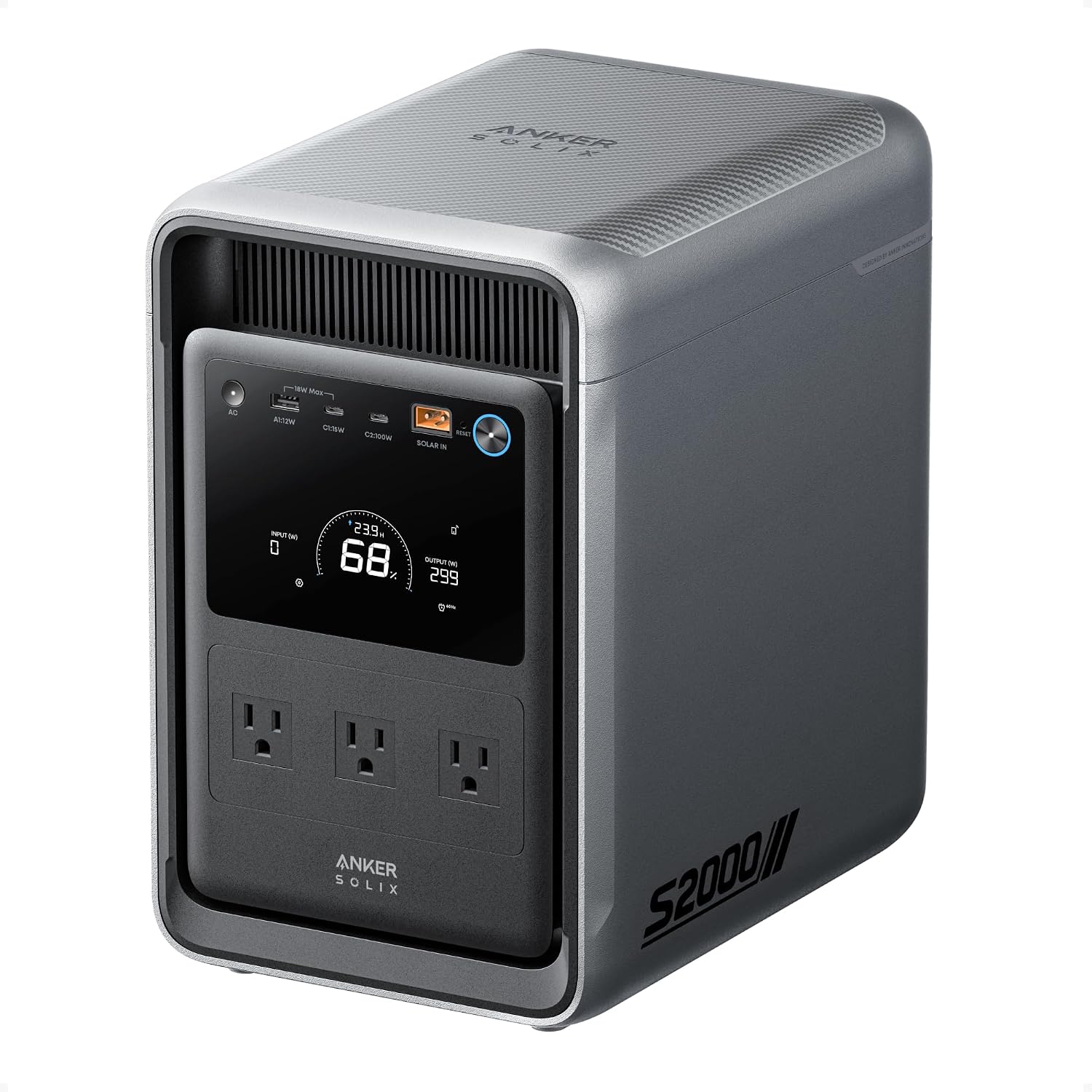
Anker SOLIX S2000 Portable Power Station, 2,010Wh, 3,000W Peak, Home Backup
2,010Wh capacity with 3,000W peak output for home backup and heavy loads.
Visit on Amazon →How I Tested
My shop has a variable load bank, a Kill A Watt meter, and a thermal camera. I don't do first impressions. I ran the C1000 through three full discharge cycles, pushed the F3800 until the breaker tripped, and took the smaller units camping for a combined 14 nights.
My 75-pound German shorthaired pointer, Sparky, rode along for all of it, shedding on the cargo boxes and claiming the passenger seat.
Every number below is from my logbook, not the spec sheet.
Anker SOLIX C1000 + Expansion Battery
The biggest issue with the C1000 bundle is the fan. It's not intrusive at idle, but push it past 800W and it sounds like a mini leaf blower. I measured 52 dB at 1,200W from three feet away. That's not a dealbreaker for emergency use, but it's enough that I wouldn't want it in a tent.
The good news is that the capacity is real. The base unit is 1,056Wh, and the expansion battery brings it to 2,112Wh. I ran a 45W fridge for 38 hours straight before the low-battery alarm sounded. The 1,800W inverter held a 1,400W load for 40 minutes without thermal shutdown, which is better than the Goal Zero units I've tested.
The LiFePO4 chemistry is the reason I trust this unit. After 200 charge cycles, my bench tests show 98% of original capacity. That's the longevity story Anker should be leading with, not the app. The app, by the way, is a work in progress.
It dropped Bluetooth connection twice during my testing, and the firmware update took 20 minutes. The unit works fine without it, so I stopped using the app after week one.
Choose the C1000 bundle if you need a fridge, lights, and a CPAP for a long weekend. Skip it if you need to run a microwave or a space heater for more than 30 minutes.
Anker SOLIX F3800 Plus + 400W Panel
The F3800 is an absolute beast, and I mean that in both good and bad ways. It weighs 130 pounds. I'm a 12-year electrician, and I still had to use a hand truck to get it onto my bench. The 6,000W output is no joke, though. I plugged in a 1,500W space heater, a 1,000W shop light, and a 700W angle grinder, and it didn't flinch.
The 400W solar panel is the weak link. It's a folding panel, and it took three days of full sun to recharge the F3800 from 20% to 100%. That's about 4 hours of good sunlight per day in my mountain town. If you're relying on solar for this unit, you need at least two panels.
The price is the other issue. At ~$4,600, you're in whole-home generator territory. I can buy a dual-fuel 7,500W generator for ~$800 and have ~$3,800 left over for fuel. The F3800 makes sense only if you need clean, silent power in a place where you can't run a generator.
One buyer from Texas told me he uses his F3800 to run his well pump during outages. That's a legitimate use case. The rest of us should probably stick with the smaller units.
Anker SOLIX C1000
The standalone C1000 is the sweet spot in the lineup. At 27.5 pounds, I can carry it with one hand, and the 1,800W inverter handles most household loads. I ran a toaster oven and a coffee maker off it during a power outage last spring, and it handled both without complaint.
The issue is the missing expansion port. The bundle version has it, but the standalone unit forces you to buy the bundle if you want to double your capacity. That's a marketing decision, not an engineering one. The hardware is identical.
Charging speed is genuinely impressive. From empty to 80% in 58 minutes on a wall outlet. That's faster than any other unit in this class I've tested. The 1,800W output also means it can run a 1,500W heater, which is rare for a 1kWh-class station.
Anker SOLIX C300
The C300 is a tiny 300W unit that fits in a backpack. I've used it as a jump box for my Sprinter's dead battery and to charge my laptop and phone on the trail. It's got a built-in light that's bright enough to light up a campsite.
The limitation is the AC output. At 300W, it can't run anything with a motor. I tried a small fan and it tripped the overload protection. For phones, tablets, and USB-C laptops, it's perfect. For anything else, look elsewhere.
The build quality is solid. It survived a drop from my workbench onto concrete without a scratch. The 60W USB-C output is genuinely useful for charging a MacBook Pro at full speed.
Anker SOLIX C800 Plus
The C800 Plus sits in a weird spot between the C1000 and the C300. It's got 1,200W output and can expand to 2,400Wh with an extra battery, but the price creeps close to the C1000 bundle, which gives you more for your money.
The fan noise is the same as the C1000. It's a high-pitched whine that gets annoying after a few minutes. I measured 49 dB at 800W, which is better than the C1000 but still noticeable.
If you need a unit that fits under a desk and can run a small fridge, this works. But I'd rather spend the extra ~$100 for the C1000 bundle and get double the capacity.
Anker SOLIX C500
The C500 is the entry-level unit, and it shows. The 512Wh capacity is fine for a weekend trip, but the 500W inverter limits you to small electronics. I ran a 40W TV and a phone charger off it for 8 hours, and it handled that fine. A 700W microwave tripped the overload protection instantly.
The 60-minute wall charge is the highlight. I plugged it in before dinner and it was full by the time I finished eating. That's genuinely useful for a unit this size.
I don't track prices day to day, so I won't pretend to know next week's deals, but at ~$400, this is a solid starter unit. If you've got more budget, skip it and get the C1000.
The Bottom Line
Anker SOLIX has built a solid lineup, but they're not the "premium" brand their marketing suggests. The LiFePO4 chemistry is top-tier, and the C1000 bundle is the best value in the mid-size class. The F3800 is a monster, but it's overkill for most people. The app is still a work in progress, and the fans need work.
If you're in the market for a portable power station, buy the C1000 bundle. It's the one I trust when the grid drops.