How-To Bestpowerstation Decision Guide 24: Start With the Load
A portable power station decision gets made backward more often than it should. Someone sees a large wattage number, adds a solar panel, and only later checks whether the charger actually fits the station. This how-to bestpowerstation decision guide 24 starts at the other end: identify the load, identify the input, then decide whether the accessory or the station itself is the part you need.
The short version is simple. If your problem is a missing or failed charger, buy a compatible replacement only after matching voltage, current, connector, and model family. If your problem is insufficient runtime, a replacement adapter will not add battery capacity. If your problem is an outage or an appliance load, a charger accessory is the wrong category entirely.
That distinction sounds obvious. Amazon listings make it surprisingly easy to miss.
The first decision: station, charger, or cable?
Before comparing products, write down what is actually failing.
- The battery box runs normally but will not charge because the original AC adapter is lost or dead: investigate a replacement charger.
- The adapter powers on but the station still refuses input: do not assume the adapter is the fault. Check the station, connector, and input settings first.
- The station charges but runs out too quickly: calculate watt-hours and load draw. A different charger will not change runtime.
- You need to run a fridge, heater, CPAP, or other AC appliance: check continuous output, surge behavior, and usable watt-hours. A small accessory is irrelevant to that decision.
- You want faster charging: find the station's maximum accepted input before buying a higher-rated supply. The internal charge controller is the limit. A larger number printed on an adapter does not force the battery to accept it.
This is where the product evidence matters. The two supplied ASINs are charging accessories, not complete portable power stations. One is a vhbw replacement adapter for several Jackery Explorer models. The other is a T POWER adapter for multiple Goal Zero Yeti and Sherpa models. Neither should be described as a battery, inverter, solar generator, or replacement for a station.
Build a compatibility note before ordering
Do not rely on a listing title that says “compatible with portable power stations.” Copy the exact model printed on your unit and compare it with the adapter's supported models.
For the vhbw adapter, the supplied product record names Jackery Explorer 160, 240, 300, 500, and 550, along with E300, E500, E550, and Honda 290 compatibility. Its description specifically says it is not for Explorer 1000, Explorer 1000 Pro, Explorer 1500, or Explorer 2000 models. That exclusion is more useful than a broad title. If your unit is one of those excluded models, stop there.
The same record identifies a 24V DC output at 3.75A and a barrel connector. The product information also lists 90W in the description and 150W in a wattage field, which is an inconsistency worth treating cautiously. I would use the explicit output voltage and current as the starting compatibility check, then verify the station's own input label and the seller's current listing before connecting anything.
The T POWER adapter is a different fit. Its record identifies an 8mm jack and compatibility with Goal Zero Yeti 150, 400, 200X, 500X, 1000, 1250, and several related Yeti Lithium and Sherpa models. It lists 16V output and 5A current, with an input range of AC 100V to 240V. That is not interchangeable with the Jackery replacement merely because both are described as AC adapters for portable power equipment.
A decision note should contain five lines:
- Station brand and exact model.
- Station input voltage.
- Station input current or wattage.
- Connector type and polarity, if printed.
- Adapter model list and output specification.
If any line is unknown, the correct next step is more verification, not a guess.
How to read voltage, current, and wattage
Voltage is the non-negotiable starting point. An adapter must provide the voltage the station is designed to accept. Current describes the maximum available flow. Wattage is calculated from voltage multiplied by current, but marketplace records can contain conflicting fields, so do not use a lone wattage number as proof of fit.
For example, 24V at 3.75A works out to 90W. That calculation agrees with the vhbw description's stated 90W output, even though another field lists 150W. The conservative interpretation is to treat the explicitly stated 24V and 3.75A as the important electrical facts and confirm the station's input requirements.
The T POWER record states 16V at 5A, which works out to 80W, while another product-details field lists 65W. Again, the safe approach is not to pick the more attractive number. Match the station's requirements and use the manufacturer's or seller's current compatibility information.
This is the sort of detail that gets lost when a buyer searches only for “fast charger.” Fast charging is not a universal feature. The station decides how much it draws, and the wrong voltage can damage equipment.
Product evidence: what these two accessories are for
vhbw replacement charger for selected Jackery models
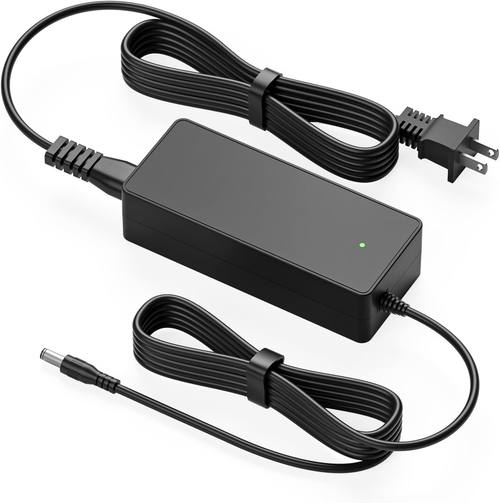
The vhbw product record describes a replacement charger with a barrel connector for selected Jackery Explorer models. It lists a 24V, 3.75A output, a 10-foot cable, and compatibility with Explorer 160, 240, 300, 500, and 550 families plus named related models. The supplied price is $17.84, but marketplace prices can change, so check the current listing before ordering.
Its main strength is specificity for the older and smaller Jackery model families named in the record. Its main limitation is equally specific: the description excludes Explorer 1000, 1000 Pro, 1500, and 2000. Do not treat it as a universal Jackery charger. The brand field identifies vhbw, while the listed manufacturer is SHENZHEN HENG TAI YING TECHNOLOGY CO., LTD.
T POWER 16V adapter for selected Goal Zero equipment
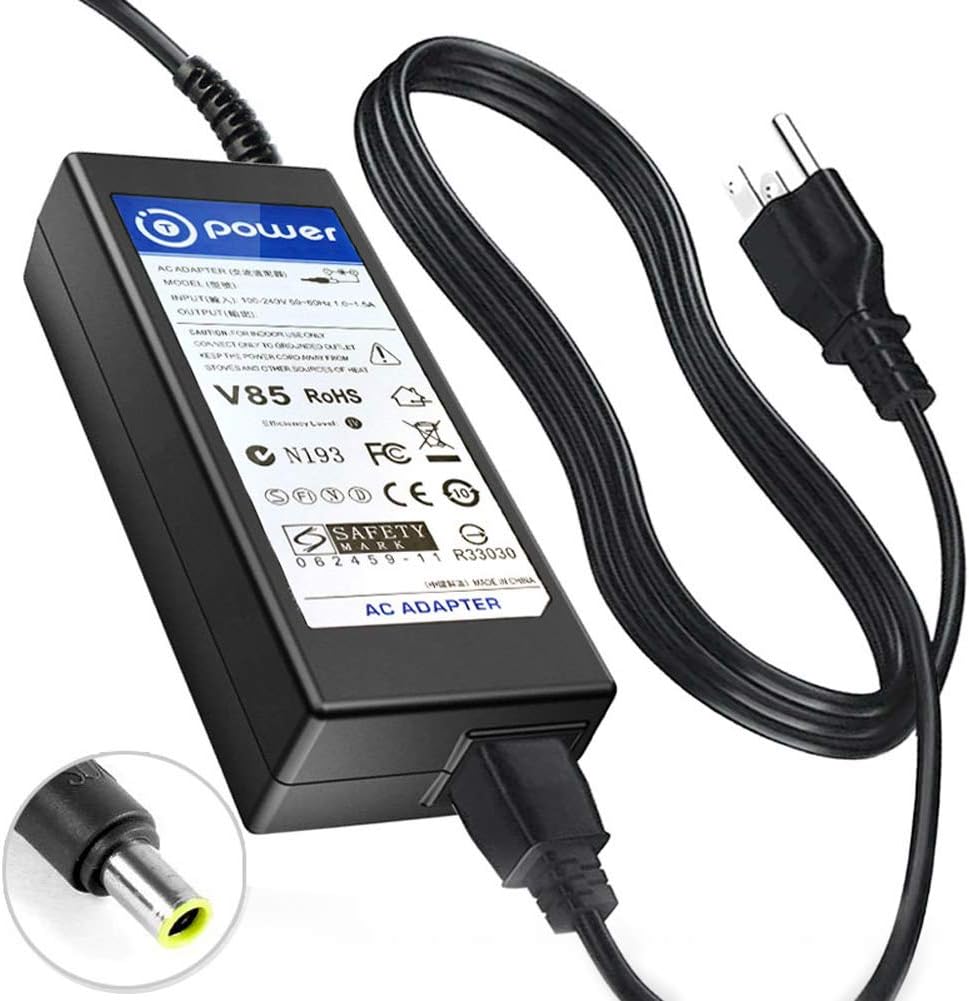
The T POWER record describes an AC adapter with an 8mm jack for selected Goal Zero Yeti and Sherpa equipment. It lists 16V output at 5A, a five-foot cable, and a North American two-pin plug. The supplied buy-box price is $20.99. Its listed compatible models include Yeti 150, 400, 200X, 500X, 1000, 1250, related Yeti Lithium units, and Sherpa models.
This is the better match only when the station is from that Goal Zero family and its input requirements agree with the adapter. It is not a substitute for the vhbw Jackery adapter. The product record also includes protection claims and a one-year limited warranty, but those claims do not replace a model and voltage check.
How to troubleshoot a station that will not charge
Start with the least destructive checks.
- Disconnect the adapter from the station and inspect the plug, cable, and housing for damage.
- Confirm the wall outlet works with another device.
- Read the station's input label and compare it with the adapter output.
- Confirm the plug is fully seated. A connector that fits physically can still be electrically wrong.
- Check whether the station has a separate input switch, charging indicator, or required power button sequence.
- Try the original adapter if it is available. If the original works, the replacement may be incompatible or defective. If neither works, the station may be the fault.
- Stop if the adapter becomes unusually hot, smells burnt, sparks, or causes the station to behave erratically.
Do not test an uncertain adapter by repeatedly forcing the connector into the port. The cheaper part is not worth damaging the battery management system or input circuit.
A useful troubleshooting result is not simply “it did not charge.” Note whether the station showed an input icon, displayed incoming watts, warmed the adapter, or shut down. Those observations help separate an input mismatch from a dead accessory.
How to decide whether faster charging is realistic
A replacement adapter can only help if the original adapter is the limiting factor and the station accepts more input through the same port. Many stations have a fixed internal charger limit. If that limit is lower than the replacement's available output, the station will draw only what it can use.
The decision sequence is:
- Find the station's maximum AC or DC input.
- Compare it with the original adapter's output.
- Confirm the replacement has the same voltage and connector requirements.
- Check whether the station has a separate solar, USB-C, or vehicle input.
- Consider heat and ventilation during charging.
Do not connect adapters in parallel unless the manufacturer explicitly supports that arrangement. Do not assume a higher current rating makes an adapter “faster” when voltage, polarity, or connector requirements differ.
Solar charging has a separate set of limits. A solar panel, adapter, and station must all agree on voltage range, current limit, and connector wiring. A wall adapter replacement cannot be treated as a solar input upgrade.
When the right answer is a new power station
A charger accessory makes sense when the battery station itself still meets your load needs and the only problem is the missing or failed input supply. It is the wrong answer when the station cannot run the appliance you need, has inadequate watt-hours, or is no longer reliable.
Use watt-hours for runtime and watts for instantaneous load. A station that can accept an 80W charger is not necessarily capable of powering an 80W appliance for a full day. Charging input and AC output are different specifications.
For an outage, list the loads you actually need: router, lights, medical equipment, refrigerator, or communications gear. Add their wattage and estimate hours of operation. Then account for inverter losses and startup surges. That load calculation tells you whether to repair the charging path or replace the whole station.
Dan's rule is plain: the spec sheet is a promise; the meter is the truth. When no meter data is available, conservative assumptions beat a confident runtime claim.
Final decision checklist
Before ordering either supplied accessory, confirm:
- The exact station model appears in the product's compatibility list.
- The adapter voltage matches the station's required input.
- The current and connector match.
- The plug polarity is correct.
- The product is an adapter, not a complete power station.
- The current Amazon listing still shows the same specification and price.
- You have a return path if the station does not recognize the adapter.
Choose the vhbw option only for the named Jackery families and only after checking the exclusions. Choose the T POWER option only for the named Goal Zero Yeti and Sherpa families and only after checking the 16V, 5A, 8mm-jack specification against your unit.
If your goal is more runtime, more AC output, or multi-day backup, stop shopping for chargers and size a complete portable power station around the real load. That is the decision that prevents the most expensive mistake.