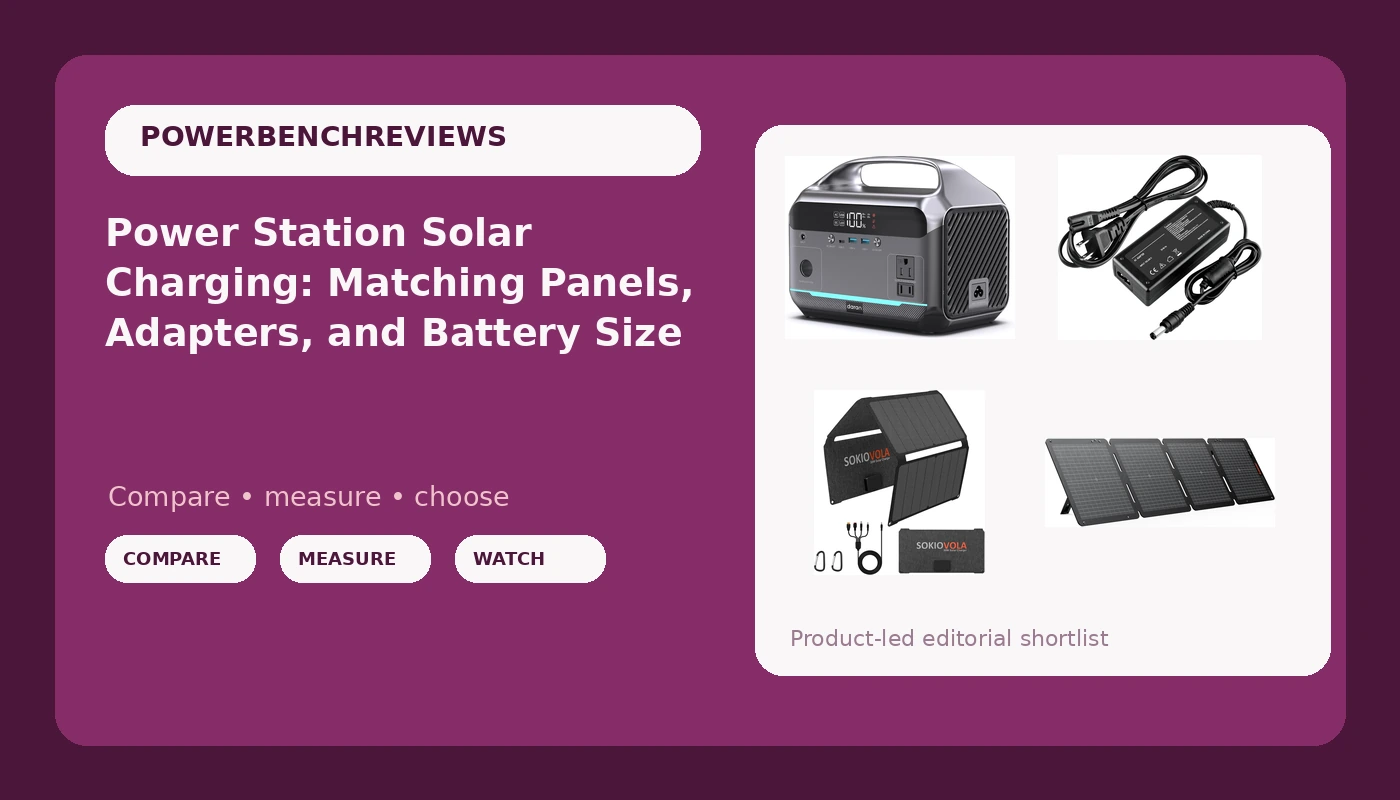
Solar charging a portable power station looks simple on a product page: buy a station, buy a panel, plug them together. In practice the panel and the battery have to agree on voltage, connector type, and how much energy can actually move in a day, and that is where most buyers end up disappointed. This explainer walks through a small, coherent portable power station solar charging setup built around a 288Wh LiFePO4 unit, a replacement wall adapter, a 50W folding panel, and a 100W bifacial panel. It covers what each piece does, where the math gets uncomfortable, and which parts you can safely skip.
Related: How Many Watts of Solar Do You Need to Recharge a Power Station? →
Quick answer
Size the panel to the battery, not the other way around. A 288Wh station is a modest storage bank, so a 50W or 100W panel is a sensible pairing for a day of decent sun, while a 15V 60W AC adapter is what refills the same class of station from a wall outlet when solar is not an option. Match the connector and the DC input voltage first, compare wattage second, and treat every nameplate number as a ceiling rather than a promise.
Four useful options
| Model | Best fit | What stands out |
|---|---|---|
| DARAN Portable Power Station 1200W Surge, 288Wh LiFePO4 | The storage side of the kit | 288Wh LiFePO4 capacity, 1200W surge rating, AC outlets, 100W USB-C PD |
| 15V AC/DC Adapter Compatible with GRECELL T300 300W (Peak 600W) | Replacing a lost or failed wall charger on a GRECELL T300 | 15V 4A output at 60W, matched to the T300 input specification |
| SOKIOVOLA [Upgraded] Foldable Solar Panels 50W | Packable top-up charging on foot or in a small rig | Folds flat, three output ports (USB-A, USB-C, DC) |
| Jackery SolarSaga 100W Air Solar Panel, Bifacial | More solar watts from an established panel brand | 100W bifacial panel built for the Jackery ecosystem |
The storage side: DARAN Portable Power Station 1200W Surge, 288Wh LiFePO4
One number deserves attention before anything else. A surge rating is a short-duration figure, and the listing leads with 1200W surge rather than a sustained output number. Surge is what a motor or a compressor pulls for a fraction of a second at startup; sustained output is what the inverter can hold while your load runs. Any buyer planning to run a device with a motor should find the sustained wattage on the spec panel and compare it to the device's running watts, not its startup watts. Capacity is the other half of the story: 288Wh is roughly a weekend of phone, laptop, light, and fan duty, not a refrigerator for three days. That is fine, as long as you buy it knowing it.
The wall charger: 15V AC/DC Adapter Compatible with GRECELL T300 300W (Peak 600W)
Here is the part that catches people. Adapters are sold by voltage, amperage, and barrel size, and the listing here names one station family. It is not a universal charger, and it is not the charger for the DARAN station above unless the DARAN's input voltage, polarity, and plug dimensions happen to match, which you would have to confirm from its own documentation rather than assume. The safe rule for any replacement supply: voltage must match exactly, amperage must meet or exceed the original, and the barrel must fit both the diameter and the polarity. Get voltage wrong and you can damage the station. Get the barrel wrong and nothing happens at all.
The compact panel: SOKIOVOLA [Upgraded] Foldable Solar Panels 50W
Do the arithmetic before you buy this one, because the arithmetic is the whole argument. A 50W panel feeding a 288Wh battery works out to about 5.8 hours of charging at full nameplate output with zero losses. Real sun is not full nameplate output, panels get hot and lose efficiency, cables lose a little, and the charging path loses a little more. A realistic expectation for a 50W panel is that it keeps a small station topped up over a long, clear day and struggles to fully refill a depleted one. That is a fair trade for a panel you can carry. It is a bad trade if you expect overnight results.
The larger panel: Jackery SolarSaga 100W Air Solar Panel, Bifacial
Run the same math here: 100W into 288Wh is about 2.9 hours at full nameplate output, again with no losses. Double the panel roughly halves the charging time in good conditions, which is the entire reason to spend more on solar. The bifacial gain is real but situational, and it depends on what the panel is sitting on; a dark asphalt pad reflects far less than fresh snow. The bigger consideration is the connector. Panels in a brand ecosystem often use a proprietary plug, and adapting one to a station from another brand may require an adapter cable or may not work at all. Check the connector on both ends before you commit.
Prices and availability may change. Product images, names, and retailer links are matched to verified listings. No current price, rating, stock status, or measured result is stated here without current evidence.
Watt-hours, watts, and the math that matters
Two units do all the work in this category, and mixing them up is the most common buying mistake. Watt-hours measure energy, which is storage: how much work the battery can do over time. Watts measure power, which is flow: how fast energy moves in or out. A 288Wh battery holds a fixed amount of energy. A 50W panel moves energy in slowly. A 1200W surge rating describes a brief, fast outflow that the battery can support for a moment.
That distinction explains every disappointing solar setup. A buyer looks at a 288Wh station and a 50W panel, sees two numbers that feel compatible, and assumes the panel refills the station in an hour. It cannot. The panel's 50W is a rate, and the battery's 288Wh is a quantity, so the honest calculation is 288 divided by 50, which is about 5.8 hours under perfect conditions. Perfect conditions are rare.
Losses compound the gap. Inverters, charging circuits, cables, heat, and panel angle all take a cut, and a rule of thumb in this class is that you should expect meaningfully less than the nameplate math suggests. Shade on even one cell of a panel can pull production down harder than the shaded area implies, because cells are wired in series and the weakest one limits the string. Depth of discharge matters too: running a LiFePO4 pack down to empty every cycle is harder on it than shallow cycling, and LiFePO4 tolerates that abuse better than older chemistries, which is the main reason to prefer it.
Matching connectors, voltage, and charge controllers
The electrical details decide whether your kit works at all. Work through them in this order.
- Find the station's DC input specification. Voltage, amperage limit, and connector type. This is the constraint everything else has to satisfy, and it is usually printed near the input port or listed in the manual.
- Check the panel's output voltage and connector. A panel rated for one voltage range may not sit inside the station's accepted window, and a barrel plug or Anderson-style connector has to physically match.
- Confirm where the charge controller lives. Many modern stations have MPPT or PWM charging built in, which means the panel feeds raw DC and the station manages it. If the station does not, you need an external controller between panel and battery.
- Add up your actual daily watt-hours. Multiply each device's watts by the hours you run it, total the list, and compare it to both the battery capacity and what the panel can realistically harvest in a day.
- Verify with a meter before trusting the chain. A clamp meter or an inline watt meter shows what is actually flowing, which is the only number worth planning around.
Practical guidance for a small solar kit
- Keep the panel aimed at the sun and reposition it through the day; a fixed, badly angled panel can lose a large share of its rating.
- Expect heat to cost you output. Panels on a hot surface in direct sun produce less than the same panel on a cool, breezy day.
- Keep cable runs short and sized for the current; voltage drop on thin, long cables quietly eats charging watts.
- Buy a spare wall adapter for your station now, not after you lose the original, and store it with the unit.
- Match panel wattage to how you actually camp. A 50W panel suits topping up a small station; a 100W panel suits refilling one.
- Do not assume a panel from one brand plugs into a station from another without an adapter or a connector change.
Which option should you choose?
Choose the DARAN Portable Power Station 1200W Surge, 288Wh LiFePO4 when you need the storage itself: a compact LiFePO4 bank with AC outlets and USB-C PD for camping, RV trips, emergency backup, and CPAP duty. Choose the 15V AC/DC Adapter Compatible with GRECELL T300 when you already own a GRECELL T300 and the original power supply is lost, damaged, or unreliable, and you have confirmed the voltage and plug match. Choose the SOKIOVOLA [Upgraded] Foldable Solar Panels 50W when portability outranks speed and you want a panel that also charges phones and tablets directly. Choose the Jackery SolarSaga 100W Air Solar Panel, Bifacial when you want more solar watts, you value the bifacial design, and the connector matches the station you own or you are willing to sort out an adapter.
One caveat runs through all of it: these are listing specifications, not bench measurements. The surge rating on the station is not a sustained output figure, the panel wattages are nameplate ratings that assume ideal sun, and the adapter's compatibility is stated for one specific station model. Confirm voltage, connector, and sustained output for your own gear before you buy, and recheck the current listing details, since specifications and availability can change.
The bottom line
A small solar setup is a chain, and the weakest link sets the result. A 288Wh LiFePO4 station with a 100W panel is a workable pairing for a weekend of light loads and a day of good sun, while the same station with a 50W panel is a top-up tool rather than a refill tool. The wall adapter is the piece nobody thinks about until it is gone, and it is the cheapest part of the whole system. Buy the storage you need, buy a panel that matches your patience, verify the connectors, and treat every nameplate number as a starting point for your own math.