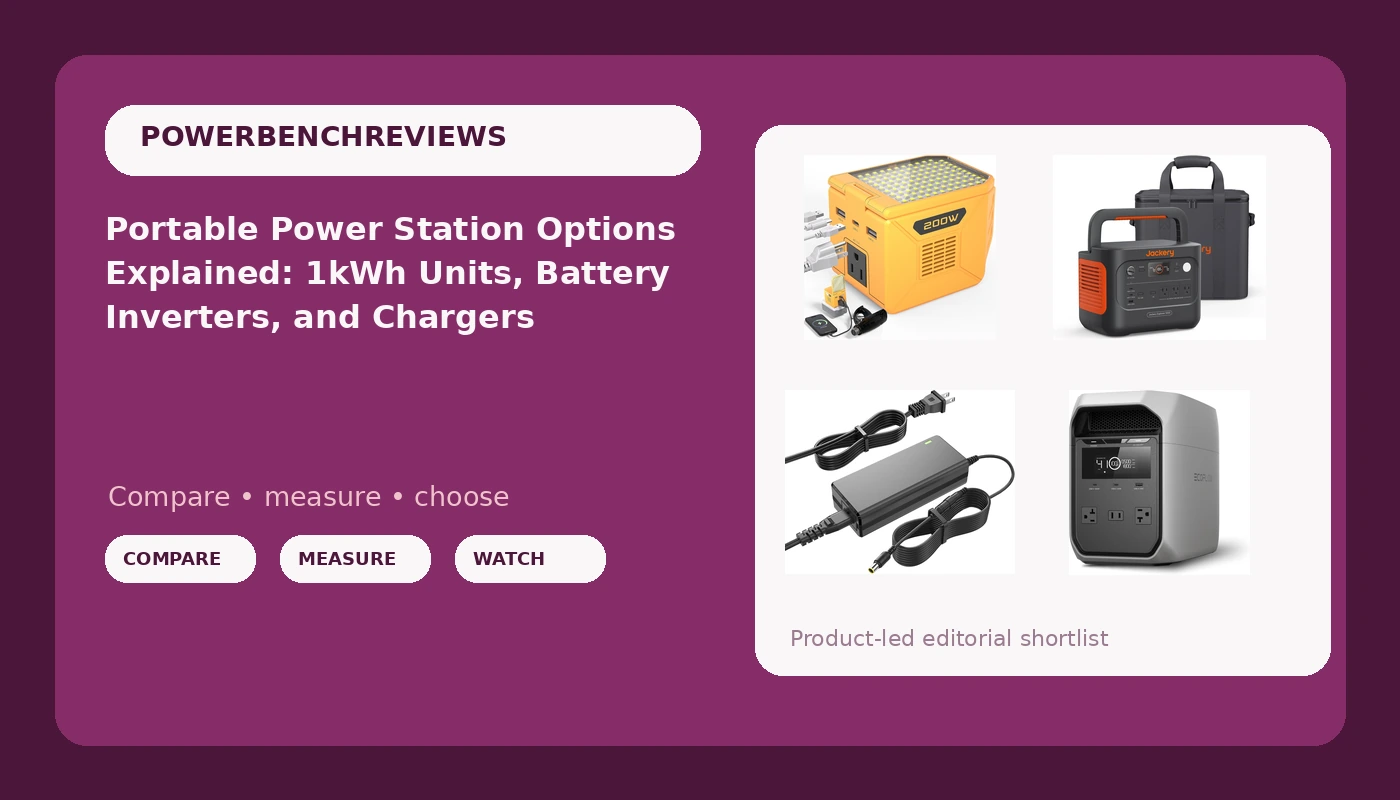
Portable power station options cover more ground than most shoppers expect. There are 1kWh class units built to carry a fridge, a CPAP machine, or a laptop through a long outage. There are small inverters that turn a cordless tool battery you already own into a 110V outlet. And there are replacement chargers that keep an older unit in service instead of pushing it to the back of the shelf. All three types land in the same search results wearing the same marketing language, and none of them answer the only question that matters: what will this run, and for how long? This explainer walks through four specific products, what each one is actually for, and how to run the numbers before you spend.
Related: How to Size a Power Station Without Wasting Money →
Quick answer
Match the product to the load, not to the brand name. A 1kWh class station with a 1,500W to 1,800W AC inverter covers what most households run during an outage: lights, phones, a router, a laptop, a fan, and a refrigerator cycling on and off. If you already own DeWalt 20V batteries, a 200W inverter adapter turns them into a small AC and USB supply for lights, tools, and charging. If you own a Goal Zero Yeti 150, 400, 200X, or 500X and the charger has failed, a 15V replacement keeps that unit working. Buy the large battery only when the watt-hour math says you need it.
Four useful options
| Model | Best fit | What stands out |
|---|---|---|
| EF ECOFLOW Portable Power Station Delta 3 Classic, 1024Wh 1800W AC | Household backup and van use in the 1kWh class | 1,024Wh capacity with an 1,800W AC inverter rating |
| Jackery Explorer 1000 v2 and Carrying Bag,1070Wh,1500W AC | The same 1kWh class with a bag included | 1,070Wh capacity, 1,500W AC output, carrying bag in the listing |
| Power Inverter for DeWalt 20V Battery 200W (350W Peak) | Tool owners who want AC from batteries they already own | 200W continuous and 350W peak, 110V AC, two USB-A, one USB-C, 500 LM light |
| 15V Charger for Goal Zero Yeti 150 400 200X 500X | Owners of an existing Yeti with a dead charger | 15V charging for the listed Yeti models |
The main 1kWh unit: EF ECOFLOW Portable Power Station Delta 3 Classic, 1024Wh 1800W AC
Here is the trade-off. Watt-hours are weight and money, and the 1kWh class is where a unit stops being something you toss in a daypack and becomes something you plan around. The other half of the trade-off is that a printed capacity number is a promise, not a reading. Inverter losses, depth of discharge, and cold temperatures all take a bite out of the label before your devices see anything, which is why the runtime math in the next section matters more than the box. Buy this class of station when the load list genuinely adds up to hundreds of watt-hours per day, not when you want to charge a phone.
The second 1kWh option: Jackery Explorer 1000 v2 and Carrying Bag,1070Wh,1500W AC
Jackery has been in this category longer than most of the brands it now competes with, and that history cuts both ways: the name is familiar and the ecosystem is deep, but the market caught up years ago and the pricing has not always followed. Two numbers decide between this station and the ECOFLOW one. The first is 1,500W versus 1,800W of AC output, and the second is the capacity gap of about 46Wh, which is roughly half an hour of a 100W load on paper. If your largest load is a laptop, a router, and a lamp, that gap is academic. If you plan to start a fridge compressor or run a mitre saw, inverter headroom is what keeps the lights on.
The tool battery adapter: Power Inverter for DeWalt 20V Battery 200W (350W Peak)
The economics are the interesting part. If you already own DeWalt 20V batteries and a charger, this is the lowest-cost route into a small AC supply in this article, because you are buying an adapter rather than a battery. The catch is that your runtime is now your tool battery, not a 1kWh pack. A 20V 5Ah pack works out to about 100Wh of energy on paper, so do that multiplication before you plan a weekend around it. Also plan against the continuous 200W number rather than the 350W peak, because peak exists for motor starts measured in fractions of a second, and wattage quoted as surge with no sustained figure behind it is one of the oldest tricks in this market.
The replacement charger: 15V Charger for Goal Zero Yeti 150 400 200X 500X Portable Solar Generator
Chargers and cables are the parts of a power station kit that fail first, and they are also the parts people forget to pack. If your Yeti still holds a charge and only the power brick is dead, this is the inexpensive fix, and it keeps a unit that already works out of the landfill. If the battery itself no longer holds capacity, a new charger will not bring it back, and the money is better put toward a station with fresh cells. That distinction, charger failure versus battery failure, is worth ten minutes of testing before you order anything.
Prices and availability may change. Product images, names, and retailer links are matched to verified listings. No current price, rating, stock status, or measured result is stated here without current evidence.
Watt-hours decide runtime, watts decide what you can plug in
Two units get confused constantly, and the confusion costs people money. Watt-hours measure energy, which is the size of the tank. Watts measure the rate of draw, which is how fast you are pouring out of it. A station can have a large tank and a small spout, or the reverse, and you need both numbers to predict anything.
Runtime is roughly usable watt-hours divided by the load in watts. Take a 1,024Wh station feeding a 100W load: that is about ten hours on paper. In practice you subtract inverter losses, and you should not plan to run a battery to zero on a regular basis, so the real figure lands lower. That is why the label is a starting point and a meter reading is the truth.
The second number to check is continuous AC output versus peak. Continuous is what the inverter can hold all afternoon. Peak is a brief ceiling for motor starts. If a listing advertises only a peak figure with no sustained rating, treat that as a warning rather than a feature.
Waveform matters too. Motors, compressors, and anything with a switching power supply behave better on a pure sine wave output. Some cheap inverters approximate it with a stepped wave, which can cause buzzing, extra heat, or a device that simply refuses to run.
Finally, remember that DC output avoids the inverter entirely. Charging a phone or a laptop from a USB port skips a conversion step, and every conversion step costs you a slice of the tank.
How to size a station in five steps
This is the method to run before you buy any of the four products above. It takes about twenty minutes with a notepad.
- Write down every load you want to run and its wattage. Read the label on the device, or measure it with a plug-in power meter for anything that cycles, like a fridge.
- Estimate hours per day for each load. A router runs 24 hours, a lamp runs 4, a fridge compressor runs a fraction of each hour even though it is plugged in all day.
- Multiply watts by hours for each item and add the column. That total is your daily watt-hour need.
- Add 15 to 20 percent for inverter losses, and decide how deep you are willing to discharge the battery on a normal day. Most people should plan to use about half.
- Compare that final number to the station capacity, then check the continuous AC rating against your single largest load, not the total.
If step five fails, a bigger battery will not save you. You need a higher inverter rating, or you need to stop running that particular appliance from a battery.
Practical notes before you buy
- Buy battery capacity before you buy panels. A solar panel is a nice bonus for a camping trip, but it will not rescue a station that is too small for the load.
- Plan against the continuous AC rating, never the peak. Peak numbers are for motor starts measured in fractions of a second.
- Confirm the connector and voltage on any replacement charger before ordering. Proprietary plugs are common in this category and a mismatch means a return.
- A tool battery adapter is only as good as the batteries you already own, and its runtime is measured in tens of watt-hours, not thousands.
- Decide what happens when the unit fails. A charger is a cheap fix; a battery that no longer holds capacity is not, and a unit whose app stops working is a paperweight if the buttons do not do the same job.
Which option should you choose?
Choose the EF ECOFLOW Portable Power Station Delta 3 Classic, 1024Wh 1800W AC when your load list includes something with a motor and you want the most inverter headroom in this group. Choose the Jackery Explorer 1000 v2 and Carrying Bag,1070Wh,1500W AC when your loads are mostly electronics and lights, and you would rather have the bag and the slightly larger capacity. Choose the Power Inverter for DeWalt 20V Battery 200W (350W Peak) when you already own DeWalt 20V batteries and you need a small AC and USB supply for lights, tools, and charging rather than a whole-home backup. Choose the 15V Charger for Goal Zero Yeti 150 400 200X 500X when you own one of those Yeti units and only the charging brick has failed.
One caveat on all of this. The figures quoted in this article come from the manufacturer listings for each product. No runtime, noise level, charge time, or capacity result is measured or stated here, and no current price is quoted, because those change. Treat the numbers above as the claims you are being asked to buy, and let the sizing method do the deciding.
The bottom line
Portable power station options are not interchangeable, and the differences that matter are boring ones: watt-hours, continuous AC output, and whether the product is even a station at all. A 1kWh unit with a 1,500W to 1,800W inverter is the practical answer for outages and van trips, a tool battery adapter is the cheap answer for small loads when you already own the batteries, and a replacement charger is the answer when the only broken part is the charger. Size the load first, then buy the box that matches it. That order saves more money than any sale price.