Most people shopping for their first power station start with the wrong question. They ask which brand is best, or which box has the biggest number printed on it, and they end up hauling capacity they will never discharge. Portable power station sizing comes down to two measurements: how many watts your gear draws at once, and how many watt-hours it burns across the hours you plan to run it. Get those two numbers roughly right and the product decision mostly makes itself.
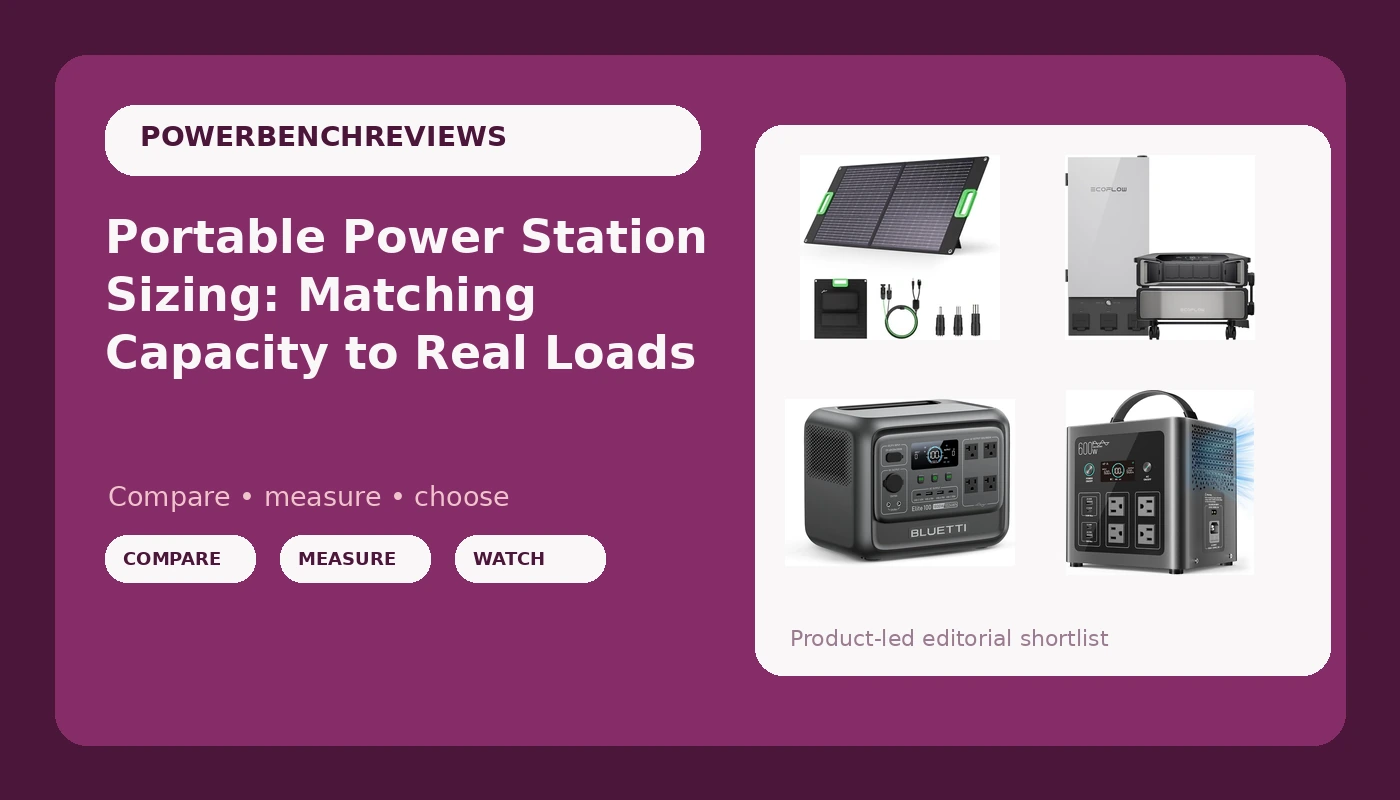
That is the whole exercise. The four products below sit in four different size classes: a 640Wh entry-level station, a 1024Wh mid-size unit, a 100W folding solar panel, and a 6000Wh home battery that expands to 90kWh. I am not going to quote current prices or hand you invented lab results. I am going to use the specs the listings state, do the arithmetic out loud, and show which loads belong to which class.
Related: How to Size a Power Station for a Weekend in a Van →
Quick answer
Match the battery to the load, not to the sale. A 640Wh station like the LIBRIDS C600 covers phones, laptops, lights, and a fan for a night or two. A 1024Wh station like the BLUETTI Elite 100 V2 adds enough headroom for a 12V fridge and a small cooking appliance. A 6000Wh home battery like the EF ECOFLOW DELTA Pro Ultra is the only unit in this group built to back up household circuits or an off-grid cabin. The 100W portable solar panel is not a power source on its own; it is a range extender for the stations above.
Four useful options
| Model | Best fit | What stands out |
|---|---|---|
| LIBRIDS Portable Power Station C600 | Light loads and short trips | 640Wh capacity with 600W output and four AC outlets |
| BLUETTI Elite 100 V2 | Camping and van use with real appliances | 1024Wh capacity behind an 1800W AC inverter |
| 100W Portable Solar Panel | Extending an existing station off grid | 100W output with a stated 23.5% cell efficiency |
| EF ECOFLOW DELTA Pro Ultra and Smart Home Panel | Whole-home backup and off-grid builds | 6000Wh base capacity expandable to 90kWh, 7200W AC output, 2-hour full charge, LiFePO4 |
The entry point: LIBRIDS Portable Power Station C600
The 600W figure is the one that sets your ceiling. Anything with a heating element, a kettle, a hair dryer, a full-size coffee maker, will either refuse to start or trip the inverter, and no amount of capacity fixes that. What the C600 does cover is the long tail of small electronics: a laptop charger around 60W, a phone around 20W, LED lights around 10W, a box fan around 50W. Add those up and you are near 150W, which the arithmetic puts at roughly four hours of everything running at once at nameplate capacity, and less once inverter losses and depth of discharge are counted. Cycled the way people actually use gear, that is a comfortable weekend, not a weekend of appliances. If your trip includes an electric kettle, this is the wrong class.
The middleweight: BLUETTI Elite 100 V2
The jump from 640Wh to 1024Wh does not sound like much on paper. The jump from 600W to 1800W does. That inverter rating is what opens up real cooking loads: a small induction burner, a microwave, an electric kettle. It also gives you surge headroom to start a compressor, which is the difference between running a 12V fridge and not running one at all. The trade-offs are weight and recharge time. A 1024Wh battery takes longer to refill from a wall outlet and longer still from a 100W panel, and it is heavy enough that you will notice the carry from the van to the campsite. For a lot of buyers this is the sweet spot: enough capacity for a fridge and lighting across a long weekend, small enough to live permanently in a vehicle.
The range extender: 100W Portable Solar Panel
Nameplate watts on a solar panel are a laboratory number. A 100W folding panel rarely delivers a steady 100W in the field, because output depends on sun angle, cloud cover, shade, and how efficiently the charge controller converts what arrives. The stated 23.5% cell efficiency tells you the panel converts more of the light hitting it than a cheaper cell would, which matters when you are short on roof or ground space. What it does not tell you is how much energy you will collect in a day. As a planning figure, four good sun hours at something below nameplate gets you a few hundred watt-hours, which is a meaningful contribution to the 640Wh and 1024Wh stations and a rounding error against a 6000Wh home battery. Before ordering, confirm the panel's connector matches the DC input on your station. Adapter hunting is the most common compatibility mistake in this category.
The home-scale option: EF ECOFLOW DELTA Pro Ultra
This is a different category of purchase. At 6000Wh the base unit carries roughly nine times the capacity of the mid-size station, and 7200W of AC output is enough to run the loads that actually matter in a house: a well pump, a furnace blower, a refrigerator, a sump pump, a few circuits of lighting. The expansion path to 90kWh is what separates it from a portable unit. You are buying a battery system you can grow, not a box you carry. LiFePO4 cells and the stated two-hour full charge are the two specs to weigh against the cost, and LiFePO4 is the chemistry I would insist on for anything that cycles regularly. The trade-offs are everything else: price, installation, and the fact that this is not a grab-and-go unit. Simple arithmetic also says that at a full 7200W draw the base battery is drained in well under an hour, so expansion batteries are not optional if you plan to ride out a long outage at high load.
Prices and availability may change. Product images, names, and retailer links are matched to verified listings. No current price, rating, stock status, or measured result is stated here without current evidence.
Watt-hours versus watts: the number that decides runtime
Watts measure speed. Watt-hours measure distance. A 600W load on a 600Wh battery runs for about an hour; the same load on a 6000Wh battery runs for about ten. That relationship, runtime equals usable watt-hours divided by draw, is the only formula you need for sizing, and it is the one marketing pages tend to bury under peak numbers.
Two adjustments keep the estimate honest. First, usable capacity is lower than nameplate capacity. Inverters lose a percentage of what passes through them, and batteries do not want to be run to zero on every cycle. A planning figure of 80 to 85 percent of nameplate is reasonable, and it is a rule of thumb rather than a measurement of any specific unit. Second, surge watts and running watts are different numbers. A refrigerator might draw 60W while the compressor runs and several times that for the instant it starts. Stations are rated for both, and a listing that advertises only a peak figure without a sustained rating is telling you half the story. Find the sustained output first, then confirm the surge rating covers your largest motor load.
Once you have both numbers, the decision collapses into a range. Light loads for a night or two land in the 500 to 1000Wh class. A fridge plus lights plus a laptop for a long weekend lands in the 1000 to 2000Wh class. Anything that has to hold up household circuits for days is not a portable station problem at all. It is a home battery problem, which is why the 6000Wh unit is in this group.
How to size a station in five steps
Do this on paper before you open a shopping tab. It takes ten minutes and it will keep you from buying twice.
- Write down every load you plan to run and its running watts. Use the label on the device or a plug-in meter, not a guess.
- Estimate the hours per day you will actually run each one. Be honest about the fridge and the fan, because they run far more than people expect.
- Multiply watts by hours for each item and add the results. That total is your daily watt-hour need.
- Divide by 0.85 to cover inverter losses and depth of discharge, then round up to the nearest available capacity class.
- Check the surge rating against your largest motor load, and confirm the station's solar input connector matches any panel you plan to pair with it.
Practical rules that save money
- Buy capacity before you buy panels. A larger battery helps every day of the year; a panel only helps when the sun is out.
- Read the sustained AC output, not the peak. That sustained number is the ceiling your appliances have to live under.
- Confirm the DC input connector on the station matches the panel before you order, because proprietary connectors are a common trap.
- Prefer LiFePO4 for anything that will cycle weekly. It handles deep discharges and high cycle counts better than older lithium blends.
- Weigh the unit before you commit. A 6000Wh battery is not something you carry to a tent, and a 640Wh unit is not something you install on a wall.
Which option should you choose?
Choose the LIBRIDS Portable Power Station C600 when your loads are phones, laptops, lights, and a fan, and you want the smallest battery that covers them. Choose the BLUETTI Elite 100 V2 when you need to run a 12V fridge or a small cooking appliance and still want something you can move by hand. Choose the 100W Portable Solar Panel when you already own a station and want to stretch it past a day or two away from an outlet. Choose the EF ECOFLOW DELTA Pro Ultra and Smart Home Panel when the load is a house or a cabin and you need circuits rather than outlets.
The capacity and output figures here come from the manufacturer listings, not from a bench test, and the runtime numbers are arithmetic on those stated specs using typical efficiency and depth of discharge assumptions. Treat them as planning estimates rather than measured results, and confirm connector types, included cables, and warranty terms on the current listing before you buy.
The bottom line
Sizing beats shopping. Write down your watts and your hours, divide by 0.85, and you will land in one of these four classes without much debate. The 640Wh station is the right answer for light loads and short trips. The 1024Wh station is the right answer for most camping and van setups. The 100W panel is a useful accessory and a poor substitute for capacity. The 6000Wh home battery is the right answer when the thing you are powering is a building. Buy the class your load puts you in, ignore the wattage printed largest on the box, and check current Amazon price on the listing before you commit.