A LiFePO4 portable power station is only as useful as the load math behind it. Most buyers start with a wattage number on the box, then find out that a 300W inverter and a 640Wh battery answer two completely different questions. One tells you what the unit can run at any given moment. The other tells you how long it can keep running before it needs a charge. Get those two numbers confused and you end up with a station that browns out on the one appliance you bought it for.
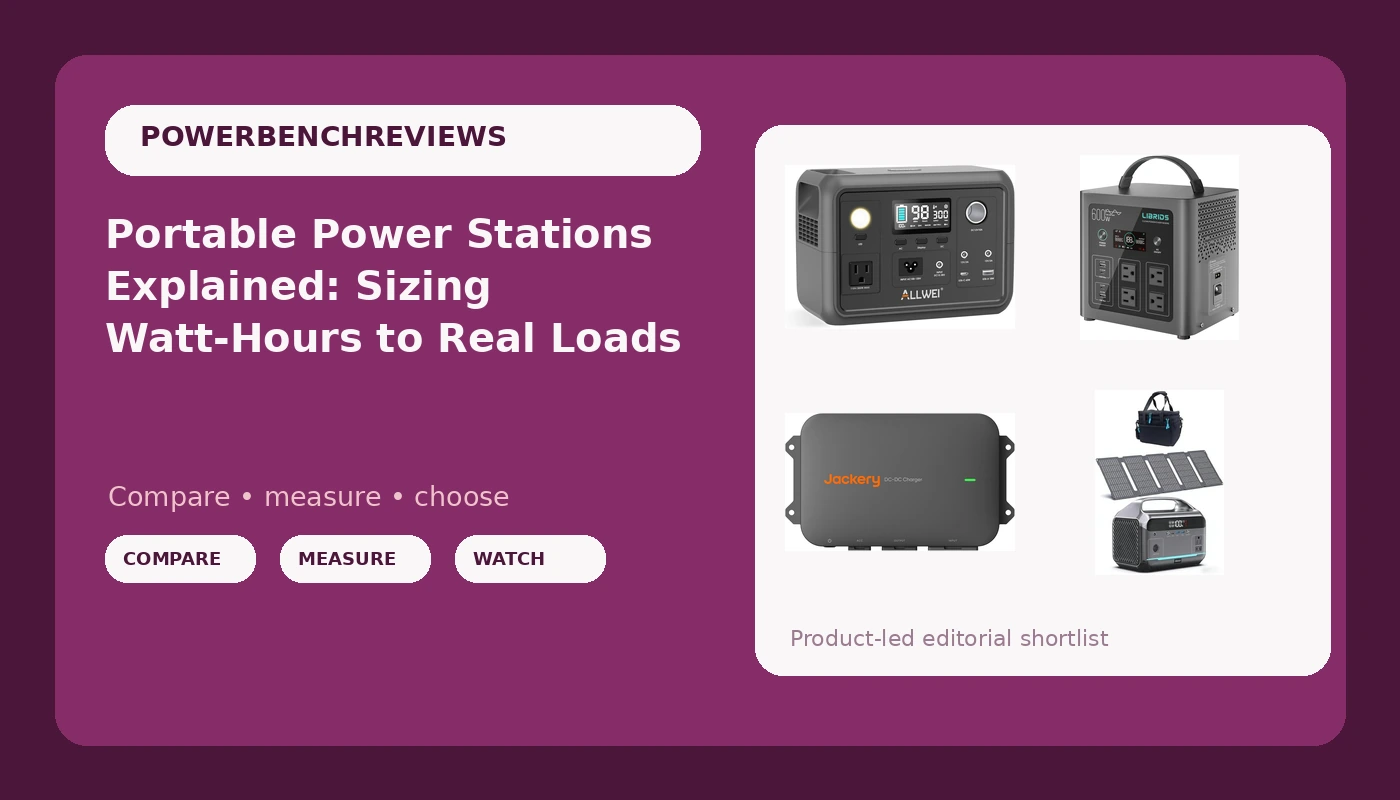
This explainer walks through four products on our bench list: a 256Wh entry unit, a 288Wh kit that arrives with a panel and a bag, a 640Wh station with four AC outlets, and a 600W alternator charger for people who charge from a vehicle. None of them is the right answer for everyone. The point is to show you which spec matters for which job, so you can size the station to your actual loads instead of to a marketing headline.
Related: How to Size a Power Station to Your Real Loads →
Quick answer
Match the battery's watt-hour rating to the total energy your devices need, and match the inverter's sustained wattage to the largest single load you plan to run at once. A 256Wh or 288Wh LiFePO4 station covers phones, laptops, LED lighting, and a small fan through a night or two of light use. A 640Wh unit with a higher surge rating stretches that into small appliance territory and longer outages. If you charge from a vehicle, a DC-DC alternator charger adds a second, faster charging path next to wall and solar. Outlet count, port types, and charging inputs matter as much as capacity, so confirm those against your gear before you buy.
Four useful options
| Model | Best fit | What stands out |
|---|---|---|
| ALLWEI Portable Power Station 300W, 256Wh Solar Generator LiFePO4 Battery | Phones, laptops, lights, small fans | 256Wh LiFePO4 capacity with a 300W inverter in a compact footprint |
| DARAN 350W Portable Power Station 288Wh with 40W Solar Panel & Carrying Bag | First-time buyers who want the panel and bag in one purchase | 288Wh LiFePO4 battery, 350W inverter, 40W panel and carrying bag included |
| LIBRIDS Portable Power Station 640Wh, 1200W Surge, Solar Generator 4 AC | Longer outages and occasional small appliances | 640Wh capacity, four AC outlets, listing states a 1200W surge rating |
| Jackery DC-DC Charger, 600W Alternator Charger | Van and RV owners who want to charge while driving | 600W alternator charging as a second charging path alongside wall and solar |
The baseline pick: ALLWEI Portable Power Station 300W, 256Wh Solar Generator LiFePO4 Battery
The trade-off here is capacity, not quality. At 256Wh you are buying roughly a night of light use, not a weekend of appliance running. Anything with a heating element, a compressor, or a motor that draws hard on startup belongs on a different list. The 300W figure is the inverter rating carried in the product name, and the number you want to compare against is the sustained rating, not a peak. If your largest device sits well under that ceiling and your total energy need is modest, this is the least capacity you need to pay for.
The all-in-one bundle: DARAN 350W Portable Power Station 288Wh with 40W Solar Panel & Carrying Bag, LiFePO4 Solar Generator Bundle for Camping, Home Emergency & RV, All-in-One Power Kit
Bundles look like deals until you do the math on watts per dollar, and panels are usually the weakest link in the package. A 40W panel will trickle energy back into a 288Wh battery over a long, sunny day, but it will not rescue a depleted station in an afternoon. What the bundle does buy you is convenience and a known-good pairing: no adapter hunting, no guessing whether the connector matches. If you plan to lean on solar as your main charging source, buy a larger panel separately. If you want solar as a backup to a wall outlet, the included panel does the job it was sized for.
The capacity step-up: LIBRIDS Portable Power Station 640Wh, 1200W Surge, Solar Generator 4 AC
This is the tier where load planning starts to matter more than capacity. A 640Wh battery runs a laptop and lights for a long stretch, but it still has a finite tank, and a device that pulls hard will drain it in a fraction of the time. The pairing you want to verify is the biggest single load against the inverter's sustained output, with a margin for startup draw on anything motor-driven. Four AC outlets also change how you use the unit in a real outage, because you can leave a router, a lamp, and a charger plugged in at once instead of rotating cables.
The van charging add-on: Jackery DC-DC Charger, 600W Alternator Charger
For anyone living out of a van, charging is the real bottleneck, not capacity. Solar works when the sun cooperates and a wall outlet works when you have one, but driving happens most days regardless of weather, which makes alternator charging the most predictable of the three. Two things to plan for: the installation involves routing cable from the vehicle's electrical system, which is a job worth doing carefully, and the charger's output has to line up with what your station will accept on its DC input. A charger rated higher than your station's input limit will simply be capped by the station.
Prices and availability may change. Product images, names, and retailer links are matched to verified listings. No current price, rating, stock status, or measured result is stated here without current evidence.
Watts, watt-hours, and surge: the three numbers that matter
The watt rating describes how much power the inverter can deliver at any instant. The watt-hour rating describes the size of the energy tank behind that inverter. Surge describes a brief peak the inverter can absorb, usually at motor startup, before it either holds or shuts down. Confusing these three is the single most common mistake in this category.
Runtime is arithmetic, not magic. Divide the battery's watt-hour capacity by the load's wattage and you get a rough hour figure, then subtract for two real-world losses. Inverters convert DC to AC and lose some energy as heat in the process, and most stations stop discharging before the battery is truly empty in order to protect it. That means usable energy is always less than the nameplate number. The same math explains why a 640Wh station does not run twice as long as a 288Wh station on a heavy load: the load does not care about the battery, it just keeps pulling.
Surge ratings deserve special suspicion. A listing that leads with a peak number and never states a continuous rating is telling you the less useful half of the story. If the continuous figure is missing, ask before you buy, because that is the number your appliance will live with after the first second.
How to estimate your real load
Do this before you compare models, not after. A plug-in watt meter is the fastest way to replace guesses with numbers, and it costs less than the difference between two station tiers.
- Write down every device you want to run, and read the wattage off its label or power supply rather than estimating from memory.
- Estimate hours per day for each device, then multiply watts by hours to get watt-hours per day for that device.
- Add the daily totals together, then add a margin of roughly a fifth for inverter losses and for the capacity you will not get back at the bottom of the discharge.
- Compare that total to each station's watt-hour rating, and separately compare your largest single device to the inverter's sustained wattage, leaving headroom for startup draw.
- Check the physical side: outlet count, port types, and whether the charging inputs you care about (wall, solar, 12V) are present and compatible with your gear.
Practical notes before you buy
- Treat a surge rating as a peak, not a continuous number, and ask for the sustained inverter rating when it is not published.
- LiFePO4 chemistry is worth prioritizing in this class, since cycle life is what determines whether the unit is still useful in five years.
- A 40W panel is a top-up, not a fast charger. If solar is your primary source, size the panel separately and treat any bundled panel as a bonus.
- For van and RV use, alternator charging turns driving time into charge, but confirm your station's DC input limit before buying a charger with a higher output.
- Check solar connector type before committing to a panel. Proprietary connectors lock you into one brand's accessories.
- Charge and store within the temperature range in the manual. Cold weather reduces usable capacity, which matters if the station lives in a vehicle.
Which option should you choose?
Choose the ALLWEI Portable Power Station 300W, 256Wh Solar Generator LiFePO4 Battery when your loads are phones, laptops, LED lights, and a small fan, and you want the smallest and most portable capacity of the group.
Choose the DARAN 350W Portable Power Station 288Wh with 40W Solar Panel & Carrying Bag, LiFePO4 Solar Generator Bundle for Camping, Home Emergency & RV, All-in-One Power Kit when you own no panels yet and want the station, panel, and bag in a single matched purchase.
Choose the LIBRIDS Portable Power Station 640Wh, 1200W Surge, Solar Generator 4 AC when you need more energy, four AC outlets, and a higher surge rating for occasional small appliances or multi-day outages.
Choose the Jackery DC-DC Charger, 600W Alternator Charger when you already have a compatible station and want to charge from your vehicle's alternator while you drive.
These are spec-level distinctions drawn from the product listings, not measured results. Manufacturers revise hardware within the same model name, so verify the sustained inverter rating, the DC input limits, and the connector types on the current listing before you commit. The capacity figures and outlet counts above come from the product names and are the right starting point for comparison, but they are not a substitute for reading the current spec sheet.
The bottom line
Size the battery to your load list, not to the biggest number on the page. Watt-hours determine runtime, sustained watts determine what you can actually plug in, and surge ratings only tell you about the first second. For light loads and short outages, a 256Wh or 288Wh LiFePO4 unit is enough, and the DARAN kit adds a panel and a bag if you want the whole package at once. Step up to the 640Wh LIBRIDS when you need more runtime and four AC outlets. If your power comes from a van or an RV, the Jackery alternator charger is the piece that makes charging predictable, provided your station's DC input matches it. Check the sustained ratings, check the connectors, and let your own load math make the call.